


Most traders spend their first year staring at a screen covered in neon lines, lagging oscillators, and complex mathematical clouds. They think that if they find the right combination of indicators, they’ll unlock a secret code to the markets. It’s a trap. I’ve seen it happen dozens of times, and it usually ends with a blown account and a lot of frustration. Forex Price Action Trading for Major Currency Pairs
The truth is much simpler. The only thing that actually moves the needle in the forex market is the raw movement of price itself. We call this price action. When you strip away the clutter, you’re left with a clean chart that shows exactly what the big players—the central banks and institutional funds—are doing with their money. If you want to trade the major currency pairs like a professional, you have to stop looking for shortcuts and start learning how to read the story that price is telling you.
Why the Majors Matter – Forex Price Action Trading for Major Currency Pairs
In the forex world, the “majors” are the heavyweights: EUR/USD, GBP/USD, USD/JPY, and AUD/USD, among a few others. I always tell people to start here because these pairs represent the highest liquidity in the world.
Liquidity is your best friend. It means you can enter and exit trades instantly without getting slaughtered by the “spread”—the cost of the trade. More importantly, major pairs respect technical levels far better than the “exotics” or cross pairs. Because millions of eyes are watching the same levels on the Euro or the Pound, those levels gain a psychological weight. When price hits a major resistance point on the EUR/USD, it’s not a coincidence that it stalls. It’s a collective realization by the market that the price is too high.
The Myth of the Perfect Pattern
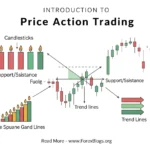
People love to memorize candlestick patterns. They see a “Pin Bar” or an “Engulfing Candle” and think it’s a green light to hit the buy button. It isn’t. A pattern in isolation is just a shape on a screen.
Context is everything. A rejection candle at a random spot in the middle of a range means nothing. But that same candle appearing at a multi-year support level? Now you have a trade. You’re looking for evidence of a shift in momentum.
More Read

Think of price action as a debate between buyers and sellers. If the price pushes aggressively into a zone and then gets slammed back down, leaving a long wick behind, the sellers just won the argument. As a price action trader, your job is to wait for the winner to emerge and then hitch a ride. You don’t need to predict the future. You just need to react to what’s happening right in front of you.
Support and Resistance: The Floor and the Ceiling
I don’t use fancy algorithms. I use horizontal lines.
The market has a memory. If the GBP/USD struggled to break above 1.3000 three times in the last six months, there’s a massive chance it’ll struggle there a fourth time. These aren’t just lines; they’re zones where orders are sitting.
I look for “Value Areas.” These are spots where the price has historically reacted. When price approaches one of these zones, I go on high alert. I’m looking for signs of exhaustion. Is the price slowing down? Are the candles getting smaller? Or is it blasting through with high conviction? If it blasts through, the old ceiling often becomes the new floor. It’s a simple concept, but it’s the foundation of every successful strategy I’ve ever used.
The Psychology of the “Fakeout”
The most profitable setups often come from other people’s failures. You’ll see this often in the major pairs. The price will break out of a well-defined range, tricking “breakout traders” into jumping in. Then, suddenly, the market reverses and snaps back inside the range.
This is a “trap.” The institutions often push price past a level to trigger stop-losses and create liquidity for their own large orders. When you see this happen—a failed breakout that closes back inside the level—it’s one of the strongest signals you’ll ever get. It shows that the big money has no interest in higher prices. I love these trades. They’re fast, they’re aggressive, and they catch the “dumb money” off guard.
Keeping It Simple – Forex Price Action Trading for Major Currency Pairs
The biggest hurdle for most traders isn’t the math; it’s the discipline.
It’s tempting to add one more indicator “just to be sure.” Don’t do it. A clean chart allows you to see the trend clearly. Is the market making higher highs and higher lows? Then you should only be looking for buy setups. Is it a messy, sideways chop? Then stay out. The best traders I know spend 90% of their time waiting and only 10% of their time actually in a trade.
You don’t need a PhD to trade the majors. You need patience and an eye for detail. Stop chasing the “next big thing” and start watching how the candles react to the levels that matter. The market tells you everything you need to know, provided you’re willing to listen instead of trying to tell it what to do.