


Most retail traders lose money because they’re looking for a secret code that doesn’t exist. They clutter their screens with colorful lines, lagging oscillators, and complex algorithms, hoping a computer will tell them when to click a button. It won’t. If you want to actually make a living—or even a decent side income—from the forex market, you have to stop looking at the math and start looking at the people. Forex Price Action Strategies for Swing Traders
Price action is the study of human behavior mapped out on a chart. It’s the footprints of the big money. As a swing trader, your job isn’t to catch every five-pip move. Your job is to find the path of least resistance over several days or weeks. You’re a hunter, not a high-frequency bot.
The Myth of the Perfect Indicator – Forex Price Action Strategies for Swing Traders
I’ve seen traders spend thousands on “proprietary” indicators. It’s a waste. Every indicator is just a derivative of price and time. By the time your MACD crosses or your RSI hits an oversold level, the move is often halfway over.
Price action is different. It’s raw. When a massive red candle swallows the previous three days of gains, you don’t need a math formula to tell you the sellers have taken control. You can see the panic. Swing trading thrives in this environment because we’re looking for the major shifts in sentiment that play out over a longer horizon.
The Foundation: Horizontal Levels
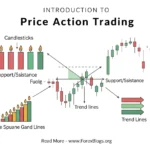
Forget diagonal trendlines for a moment. They’re too subjective. You can draw a trendline ten different ways and convince yourself of ten different stories. Horizontal levels of support and resistance are the real battlegrounds.
These are the prices where the market has historically “rejected” a move. If the EUR/USD hits 1.1000 and bounces back three times over six months, that’s not a coincidence. That’s a memory. Institutional orders sit at those levels. As a swing trader, I’m looking for these zones on the daily and weekly charts. I don’t care what’s happening on a five-minute chart. That’s just noise.
The Strategy: Trading the Pullback
Markets don’t move in straight lines. They breathe. In a healthy uptrend, price will push higher, then “inhale” back toward a previous level of resistance that has now become support. This is where you strike.
It’s counterintuitive for beginners. They want to buy when the market is screaming higher. But professional swing traders wait for the dip. I want to see price return to a “value area.” When price hits that old level and prints a rejection signal—like a long-wicked pin bar or a massive engulfing candle—that’s my cue. You’re buying from the people who are scared and selling to the people who are greedy.
The Power of the Failed Breakout
This is my favorite setup because it exploits the biggest weakness of retail traders: FOMO (Fear Of Missing Out).
Imagine a currency pair is stuck in a range. Suddenly, it breaks out above resistance. Thousands of retail traders jump in, terrified they’ll miss the “big move.” Then, the big players—the banks and hedge funds—use that liquidity to sell their massive positions. Price reverses, crashes back into the range, and leaves all those retail buyers trapped.
When you see a “false break” or a “fakey,” it’s a massive signal. If price tries to break out and fails miserably, it’s usually going to head toward the opposite side of the range with a lot of momentum. It’s a trap, and if you know how to read it, it’s one of the most profitable trades in your arsenal.
Risk is the Only Thing You Control
You can have the best strategy in the world, but you’ll still blow your account if you don’t respect risk. Most people think about how much they can win. I only think about how much I’m willing to lose.
In swing trading, your stops need room to breathe. You can’t put a tight 10-pip stop on a trade you plan to hold for four days. The market will stop you out on a random spike before the move even starts. I use wide stops based on market structure, and I adjust my position size accordingly. If I’m wrong, I lose 1% of my account. Period. It doesn’t matter if the market moves 50 pips or 500 pips against me; my loss is capped.
The Psychology of Doing Nothing – Forex Price Action Strategies for Swing Traders
The hardest part of swing trading isn’t the analysis. It’s the waiting.
We live in a world of instant gratification. People want to trade every hour. But high-probability price action setups don’t happen every hour. Sometimes, they don’t even happen every week.
I’ve had months where I only took three trades. Those were often my most profitable months. When you’re not constantly clicking “buy” or “sell,” you’re not paying the broker a spread, and you’re not getting chopped up by market volatility. You’re waiting for the fat pitch.
Swing trading with price action is a professional’s game. It requires a calm head and the discipline to turn off the computer when the market isn’t giving you anything. Stop chasing the candles. Let the price come to your levels, wait for the signal, and then execute without emotion. That’s how you survive this market.