


The forex market doesn’t care about your feelings or your carefully plotted trendlines. When volatility spikes—whether it’s due to an unexpected central bank announcement, a geopolitical shift, or a sudden economic data release—the charts turn into a battlefield. Most retail traders see this chaos and freeze. They watch their screens, paralyzed as price swings wipe out their accounts in minutes. Forex Price Action Strategies for Volatile Markets
I don’t see it that way. To me, volatility is the only time the market is actually telling the truth.
If you want to survive these periods, you have to ditch the lagging indicators. MACD, RSI, and moving averages are useless when the floor is falling out. They’re based on historical data, and in a fast-moving market, history is irrelevant. You need to read the price as it happens. You need price action.
The Psychology of the “Wick” – Forex Price Action Strategies for Volatile Markets
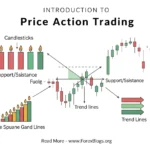
The most important tool in your arsenal during a volatile swing is the rejection candle, often called a Pin Bar. Think of it as the market’s way of saying “I tried, but I can’t.”
When you see a candle with a long tail (the wick) and a tiny body, it’s a sign of a failed takeover. In a high-volatility environment, these wicks become exaggerated. Imagine the Euro-Dollar pair screaming upward by 80 pips in ten minutes, only to crash back down and close near where it started. That long upper wick is a scar. It shows you exactly where the selling pressure is sitting.
I don’t trade the move up. I trade the rejection. When the market shows me that it can’t sustain a price, that’s my cue. It’s a high-probability signal because it shows that the “smart money” has stepped in to stop the madness.
The Coiled Spring: Inside Bars
Volatility isn’t always a straight line. Sometimes, after a massive move, the market takes a breath. This shows up on your chart as an “Inside Bar”—a candle that stays completely within the high and low of the previous candle.
Think of this as a coiled spring. The market is digesting the recent volatility and preparing for the next leg. Many traders make the mistake of trying to guess which way it will break. Don’t do that. You aren’t a psychic.
The strategy here is simple: wait for the break. Set an entry order just above the high and just below the low of that mother candle. When the market finally decides which way it’s going, it usually moves with a lot of force. You’re just catching the ride.
Why Your Stop Loss is Killing You
Let’s talk about the mistake that wipes out 90% of traders during volatile periods: tight stop losses.
We’re taught to keep our risk small. In a quiet market, a 15-pip stop loss might be fine. In a volatile market, that’s just a donation to the broker. The “noise” of the market will hunt that stop down before the real move even starts.
If the market’s volatility has doubled, you need to double your stop loss distance. It sounds counterintuitive, but to keep your risk the same, you simply cut your position size in half. If you usually trade one lot with a 20-pip stop, you trade half a lot with a 40-pip stop. You’re risking the same dollar amount, but you’re giving the trade room to breathe. I see people get the direction right all the time, only to get stopped out by a three-second spike. It’s a tragedy of bad math.
More Read

Support and Resistance are Zones, Not Lines
Stop drawing thin, precise lines on your charts. They don’t exist. In a volatile market, price doesn’t stop perfectly at 1.2500. It might blow past it to 1.2520 before reversing.
I treat support and resistance as “gray zones.” These are areas where I expect a reaction, not a specific price point. When price enters a resistance zone during a high-volatility event, I’m looking for the rejection candles I mentioned earlier. If the price just slices through the zone like a hot knife through butter, I stay away. The market is telling me that the previous structure no longer matters.
A Few Hard Truths – Forex Price Action Strategies for Volatile Markets
Trading price action in a volatile market isn’t about being right; it’s about being disciplined.
- Don’t chase the candle. If you see a massive green bar and you’re not already in it, you’ve missed it. Buying at the top of a giant candle is the fastest way to lose money.
- Check the calendar. If there’s a major interest rate decision in ten minutes, get out of the way. Price action works best when there’s a clear flow, not during the absolute peak of a news “bomb.”
- Less is more. In a high-volatility week, I might only take two trades. Most people feel they need to be “doing something” because the charts are moving fast. That’s boredom, not trading.
The market is a machine designed to take money from the impatient and give it to the patient. When the volatility ramps up, the machine just works faster. If you can keep your head, watch the wicks, and widen your stops, you’ll be the one collecting the checks.