


Let’s cut through the noise for a second. If you’re here looking for a roadmap, it probably means you’ve already dipped your toe in the water, realized the water is full of sharks, and maybe—just maybe—you’ve taken a small hit to the wallet. Forex Trading Investment Roadmap for Beginners
That’s good. No, really. It is.
You can’t learn to trade Forex by reading about how much money you could make. You learn by feeling the specific, hollow ache of watching a trade go against you because you were too stubborn to set a stop loss. The internet is littered with “get rich quick” schemes and guys posing in rented Lamborghinis, promising that a simple moving average crossover strategy is the key to financial freedom.
It’s not. If it were that easy, everyone would do it, and the market would cease to function.
The real roadmap isn’t about finding a magic indicator. It’s about surviving long enough to figure out who you are as a trader. I’ve spent years staring at charts until my eyes burned, and I can tell you that the journey from “clueless gambler” to “consistent trader” usually follows a specific, painful, yet rewarding trajectory.
Phase One: The Survival Mindset – Forex Trading Investment Roadmap for Beginners
The biggest mistake beginners make is focusing on how much they can win. They open an account with $500 and try to flip it to $5,000 in a month. That’s not trading; that’s a donation to the market gods.
Your first goal—your only goal for the first six to twelve months—should be capital preservation.
Think of your trading capital like your inventory in a retail store. If you have no inventory, you can’t do business. When I first started, I treated every dollar like it was expendable. I was aggressive. I wanted action. It took blowing up two accounts (and a serious hit to my ego) to realize that my job wasn’t to make money; my job was to protect my downside. The upside takes care of itself if you manage the risk.
So, how do you survive? You size down. Way down. If you are risking more than 1% or 2% of your account on a single trade, you are walking a tightrope without a net. A string of five losses—which happens to even the best hedge fund managers—should be an annoyance, not a catastrophe. If five losses wipe out 20% of your account, you’re emotionally compromised. You’ll try to make it back quickly, and that is when the market truly eats you alive.
Phase Two: The Methodology Hunt (and the Trap)
Once you’ve accepted that you aren’t going to buy a private island next Tuesday, you enter the “Methodology Phase.”
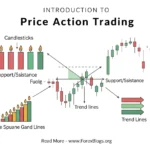
This is where things get messy. You’ll probably spend months jumping from strategy to strategy. One week you’re a price action trader looking at pin bars; the next week you’re cluttering your charts with Ichimoku clouds and RSI divergences. We call this “system hopping.”
It’s a trap, but it’s a necessary one. You have to try things on to see what fits.
Here is the secret though: The strategy doesn’t matter as much as the match.
I know traders who make a killing scalping the 1-minute chart for three hours a morning. I also know traders who look at the charts once a week, place a trade, and walk away. Both are profitable. But if you force the scalper to swing trade, he’ll get bored and force bad entries. If you force the swing trader to scalp, he’ll have a nervous breakdown.
You need to find a methodology that aligns with your personality. Are you impatient? Do you need instant feedback? Maybe you’re a day trader. Do you have a full-time job and can’t stare at screens? You’re a swing trader. Stop looking for the “best” strategy and start looking for your strategy. Pick one. Just one. And stick to it for at least 100 trades. You can’t judge a system’s edge on a sample size of three.
More Read

Phase Three: The Boredom of Execution – Forex Trading Investment Roadmap for Beginners
This is the phase where most people quit.
Let’s say you’ve survived the initial losses. You’ve found a strategy that makes sense to you—maybe it’s simple support and resistance breaks. Now, you have to execute it like a robot.
And honestly? It’s boring.
Real trading is incredibly monotonous. It’s a lot of waiting. It’s sitting on your hands. It’s seeing a setup that looks almost perfect, but not quite, and having the discipline to do absolutely nothing.
I remember a specific month a few years back. The market was chopping sideways, just ugly, erratic price action. My system gave me zero signals for three weeks. The old me would have forced a trade just to feel involved. But the experienced me knew that cash is also a position. I sat flat for three weeks. When the market finally broke out, I caught a massive move because I wasn’t busy managing losing trades I shouldn’t have been in.
This roadmap requires you to fall in love with the process, not the result. You have to get satisfaction from following your rules, even if the trade loses. Did you enter where you were supposed to? Did you set your stop loss correctly? Did you exit when the plan said to? If yes, that’s a successful trade, regardless of what the P&L says.
The Psychology Barrier
You can have the best roadmap, the best compass, and the best vehicle, but if the driver is drunk, you’re crashing.
Psychology is the final boss of trading. The market is a mirror. It reflects your greed, your fear, your insecurity, and your need to be right. Why do we move stop losses when the price gets close to them? Because we don’t want to admit we were wrong. Why do we take profits too early? Because we’re afraid the market will take the money back.
I keep a journal. Not just a spreadsheet of numbers—a real journal. I write down how I felt when I clicked the “buy” button. Was I anxious? Was I overconfident? Over time, you start to see patterns. You realize, “Hey, every time I trade the GBP/JPY pair during the Asian session, I lose money.” Or, “Every time I trade immediately after a loss to try and get ‘revenge,’ I dig the hole deeper.”
Self-awareness is your edge. The banks and algorithms execute without emotion. You can’t beat them on speed, but you can beat them by not making unforced errors.
The Long Game – Forex Trading Investment Roadmap for Beginners
If you are looking for a timeline, I’ll give you a realistic one.
Months 1-6: You will likely lose money. You are paying tuition to the market.
Months 6-12: You might break even. You stop bleeding chips, but you aren’t really growing yet.
Year 2+: You start to see consistency. The compound interest of experience kicks in.
It’s a grind. It’s lonely work sometimes. But there is a specific kind of freedom in waking up, looking at a chart, and knowing exactly what you are looking for—and having the discipline to walk away if it isn’t there.
So, forget the Ferraris for now. Focus on risk. Focus on finding a style that fits your brain. And most importantly, forgive yourself when you screw up—because you will. Just make sure the screw-up is small enough that you can come back and play the game tomorrow.