

Ever opened up a trading chart and felt like you were staring directly into the Matrix? You’re definitely not alone. Trying to figure out where currency prices are heading next can easily feel like guessing the winning lottery numbers. Forex Indicators Every Trader Should Know
That’s exactly where forex indicators come to the rescue. Think of them as your personal GPS for the trading world, helping you navigate the crazy ups and downs of the market.
When you first start out, the sheer number of tools available can be completely overwhelming. You don’t need a degree in finance to figure this out, though. Let’s break down the absolute essentials you actually need to know, without all the confusing Wall Street jargon.
What are Forex Indicators?
So, what exactly are forex indicators? Honestly, they’re just simple math formulas running behind the scenes on your trading platform.
They take past price data—like how high or low a specific currency went yesterday—and turn it into visual lines, bars, or shapes right on your chart. This helps you make sense of the chaos.
Imagine you’re driving a car down a winding road on a super foggy night. You can’t really see what’s coming up ahead, which makes driving pretty dangerous. A forex indicator is basically your set of fog lights.
It doesn’t guarantee you won’t hit a bump in the road, but it gives you a much clearer view of what’s happening around you. They help you spot trends, figure out when a currency is too expensive, or warn you when the market is slowing down.
For beginners, using these tools means you aren’t just trading on a random gut feeling. You are making educated guesses based on actual data.
Step-by-Step Guide to Using Forex Indicators
Learning to use these tools doesn’t have to be a headache. Instead of throwing a bunch of random lines on your screen, you can follow this step-by-step process to build a solid beginner trading setup.
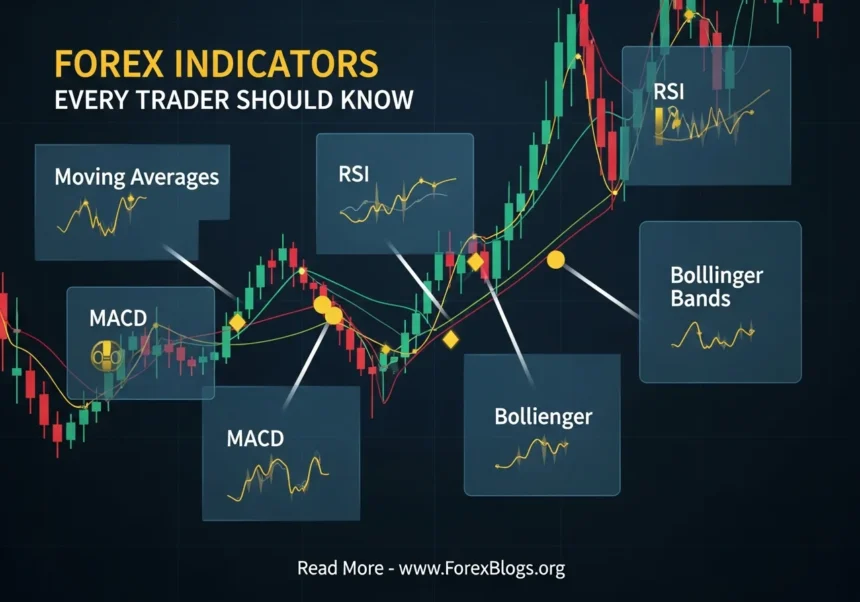
Step 1: Find the Main Trend with Moving Averages (MA) Before you even think about buying or selling, you need to know which direction the market is moving. The Moving Average is perfect for this. It smooths out all the wild, choppy price jumps and draws a single, easy-to-read line on your chart.
- How to use it: If the current price is sitting above the MA line, the trend is generally going up. If the price is below the line, it’s going down.
- Beginner Tip: Start with a 50-period Simple Moving Average (SMA). It’s a classic setting that gives you a great bird’s-eye view of the market.
Step 2: Spot Turning Points with the RSI Once you know the trend, you need to know if it’s running out of steam. The Relative Strength Index (RSI) is like a speedometer for the market. It runs on a scale from 0 to 100 and tells you if a currency is “overbought” or “oversold.”
- How to use it: When the RSI goes over 70, the currency might be overbought (too expensive) and could drop soon. If it drops below 30, it’s oversold (too cheap) and might bounce back up.
- Beginner Tip: Don’t just buy because the line hits 30. Wait for the line to cross back above 30 to confirm the price is actually turning around.
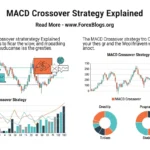
Step 3: Check the Market’s Momentum with MACD MACD stands for Moving Average Convergence Divergence. It sounds super complicated, but it’s actually a favorite among new traders. It helps you see how much energy or “momentum” is behind a price move.
- How to use it: The MACD has two lines. When the faster line crosses above the slower line, it’s a signal that buyers are taking control. When it crosses below, sellers are taking over.
- Beginner Tip: Look at the little bars (the histogram) in the middle of the MACD. When those bars start getting smaller, the current trend is losing its strength.
More Read

Step 4: Catch Big Breakouts with Bollinger Bands Markets don’t move in straight lines; they actually spend a lot of time moving sideways. Bollinger Bands help you measure how wild or quiet the market is right now. They look like a transparent channel wrapping around the price.
- How to use it: Think of the bands like a rubber band. When the market is quiet, the bands squeeze tightly together. Eventually, that pressure has to release, leading to a big price breakout.
- Beginner Tip: If the price completely pokes outside the top or bottom band, it usually snaps back toward the middle line shortly after.
Step 5: Set Safe Stop-Losses with ATR The Average True Range (ATR) is probably the most underrated indicator out there. It doesn’t tell you whether to buy or sell. Instead, it tells you exactly how much the price is moving up and down on average.
- How to use it: If the ATR says a currency pair moves about 50 pips a day, you definitely shouldn’t set a tight 10-pip stop loss. You’ll get kicked out of the trade too early.
- Beginner Tip: Use the ATR to give your trades enough breathing room. Multiply the ATR value by 1.5 to find a safe, logical place to put your stop loss.
5 Common Mistakes Beginners Make with Indicators
Even the best tools are useless if you don’t know how to handle them. Here are a few traps you need to avoid when setting up your charts.
1. Creating a “Frankenstein” Chart This is the biggest mistake new traders make. They slap ten different forex indicators on one screen until it looks like a messy Jackson Pollock painting. You can’t even see the actual price anymore! Stick to two or three tools that do different jobs.
2. Chasing the “Holy Grail” Let’s get real for a second. There is no magical indicator out there that wins 100% of the time. If someone tries to sell you a secret tool that never loses, run the other way. Losses are a normal part of trading, and no math formula can predict the future perfectly.
3. Ignoring the Bigger Picture It’s easy to get hyper-focused on a 5-minute chart because things move fast and it feels exciting. But if your 5-minute indicator says “buy” while the daily chart is in a massive crash, you’re going to get crushed. Always check the higher timeframes first.
4. Forgetting That Indicators Lag Almost all indicators use past data. That means they are “lagging” behind what the price is doing right this second. They confirm what has already happened. Never rely on them blindly without actually looking at the raw price action itself.
5. Trading During Major News Events When huge economic news drops—like inflation reports or interest rate changes—forex indicators completely stop working. The market goes crazy, and standard math formulas can’t keep up with human panic. It’s usually best to step back and watch during major news releases.
FAQs
How many forex indicators should I use at once?
Keep it simple. You really only need two or three on your chart. A good rule of thumb is to use one for the trend (like a Moving Average) and one for momentum (like the RSI or MACD). Anything more than that usually just causes confusion.
Are these indicators free to use?
Yes! Almost every trading platform, like MetaTrader 4 or TradingView, comes with all the classic indicators built right in for free. You don’t need to spend hundreds of dollars buying fancy custom tools when you are just starting out.
Do forex indicators actually work?
They definitely work, but they aren’t magic crystal balls. They work best when you use them together with basic common sense and good risk management. Think of them as helpful clues rather than absolute rules.
Conclusion
Learning how to trade the currency markets takes time, patience, and a lot of practice. The good news is you don’t have to figure it all out in a single day.
By taking the time to understand the basic forex indicators, you are already putting yourself ahead of the crowd. You’ll start seeing patterns instead of chaos, and your trading decisions will actually make sense.
The best way to get comfortable with these tools is to just play around with them. Go open a free demo trading account today. Throw a Moving Average or an RSI on your chart, watch how the lines react to the price, and have fun learning the ropes without risking a dime!
#ForexIndicators #ForexTrading #TechnicalAnalysis #TradingStrategy #FXTrading #DayTrader #ForexSignals #ForexEducation #MarketAnalysis #TradingTools #CurrencyTrading #ForexMarket #PriceAction #Investing #ForexTips #MetaTrader