

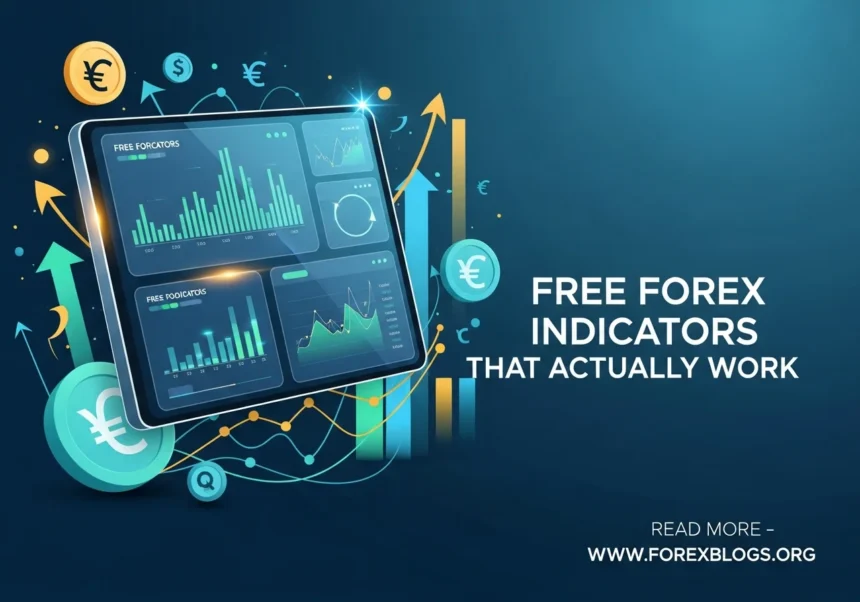
Ever stared at a forex chart and felt like you’re trying to read an alien language? You’re definitely not alone. When I first started trading, those red and green candles just looked like a chaotic, stressful mess. Free Forex Indicators That Actually Work
You probably watched a few videos online, and suddenly you’re being told you need to buy a $500 “magic” software to be profitable. Please, keep your wallet in your pocket.
The good news is you don’t need to drop hundreds of dollars to make sense of the markets. There are plenty of free forex indicators built right into your trading platform that can completely change how you trade. Let’s break down the ones that actually work, without all the confusing Wall Street jargon.
What Are Free Forex Indicators?
So, what exactly are we talking about here? Honestly, just think of trading indicators like the dashboard on your car. Your car’s dashboard tells you how fast you’re going, if you’re running out of gas, or if the engine is overheating.
Trading indicators do the exact same thing, but for currency prices. They take all that messy, confusing price data and turn it into simple visual lines or waves on your screen. This helps you spot trends or figure out when a currency is “too expensive” or “too cheap.”
Imagine trying to drive on a busy highway blindfolded. That’s what trading without any tools feels like. Using a solid indicator is like taking off the blindfold and turning on your GPS.
The best part? The most reliable tools in the world won’t cost you a dime. Platforms like MetaTrader 4 (MT4) or TradingView give them away for free because they are the industry standard.
Step-by-Step Guide: Setting Up the Best Free Forex Indicators
Ready to set up your charts? You don’t need a math degree to use these. Here is a step-by-step guide to finding and using the most reliable free forex indicators out there.
Step 1: Find the Trend with Moving Averages (MA)
Moving averages are the bread and butter of trading. They simply smooth out the choppy price movements so you can see the overall direction the market is heading.
How to set it up: Open your chart, go to your “Indicators” tab, and search for “Moving Average.” I highly recommend setting the length to 50 or 200. This means it calculates the average price over the last 50 or 200 candles.
Quick Tip: If the current price is sitting above the 200 moving average line, you should only look for buying opportunities. If the price is below the line, focus on selling. It’s a super easy way to make sure you aren’t trading against the trend.
Step 2: Spot Turning Points with the RSI
The RSI (Relative Strength Index) is my personal favorite. It tells you if a currency pair is running out of gas. It shows up as a squiggly line at the bottom of your screen that bounces between 0 and 100.
How to set it up: Add “RSI” to your chart. You’ll notice two main lines on the RSI window, usually at the 30 and 70 levels.
Quick Tip: When the line drops below 30, the market is considered “oversold.” This means sellers might be exhausted, and a bounce up could happen. If it goes above 70, it’s “overbought,” meaning it might be time for a drop. Use this as a clue, not a guaranteed signal.
Step 3: Confirm the Move with MACD
MACD stands for Moving Average Convergence Divergence. I know, it sounds super complicated, but it’s really just a tool to measure momentum. It answers the question: Is the current trend getting stronger or weaker?
How to set it up: Search for MACD and add it to your screen. You’ll see two lines and a little bar chart (called a histogram) at the bottom.
Quick Tip: Look for the moment when the two lines cross each other. If they cross pointing up, momentum is building for a buy trade. If they cross pointing down, it’s a warning sign to sell.
More Read
Step 4: Catch Breakouts with Bollinger Bands
If you are a visual learner, you are going to love Bollinger Bands. This indicator puts a “cloud” or a set of bands around the price. It expands when the market is moving fast and shrinks when the market is quiet.
How to set it up: Add “Bollinger Bands” to your chart. You’ll see three lines—an upper band, a middle line, and a lower band. The price usually stays inside these bands about 95% of the time.
Quick Tip: When the bands squeeze tightly together, it means the market is taking a nap. But watch out! A tight squeeze almost always leads to a massive breakout. When the price finally breaks out of the squeezed bands, that’s your signal to jump in.
Step 5: Put It All Together
The real magic happens when you combine these tools. Never rely on just one indicator to risk your money.
Try this simple system: Use the Moving Average to find the main trend. Then, check the RSI to see if you are getting a good price. Finally, wait for the MACD lines to cross to confirm the momentum. When all three agree, you’ve got a much higher chance of a winning trade.
Common Mistakes When Using Free Forex Indicators
It’s super easy to get carried away when you first discover these tools. You start feeling like a Wall Street pro. But here are a few massive mistakes beginners make (and how you can dodge them).
1. The “Spaghetti Chart” Syndrome
This happens when you slap 10 different indicators on your screen at once. Your chart ends up looking like a bowl of colorful spaghetti, and you can’t even see the actual price candles anymore. Keep your charts clean. Stick to 2 or 3 indicators maximum.
2. Thinking indicators predict the future
Let’s get real for a second—no indicator is a crystal ball. They are based on math formulas using past prices. They only show you what has already happened to help you guess what might happen next. Always use a stop-loss to protect your money when the market does something unexpected.
3. Ignoring the bigger picture
You might see a perfect buy signal on a 5-minute chart. But if the daily chart is in a massive, ugly downtrend, you’re just swimming against the current. You will probably lose that trade. Always check the higher timeframes (like the 4-hour or Daily chart) before you pull the trigger.
4. Chasing the “Holy Grail”
A lot of beginners hop from one indicator to another every time they lose a trade. They think the tool is broken. Stop looking for a magic indicator that wins 100% of the time because it just doesn’t exist. Pick a few reliable free forex indicators and actually take the time to master them.
5. Trading during crazy news events
Have you ever been in a trade, and suddenly a massive red candle wipes out your account in three seconds? That’s what happens when major economic news drops (like inflation data or interest rate changes). During these times, indicators completely stop working. The market goes wild. Just step away from the charts during major news releases.
FAQs About Forex Indicators
Are paid forex indicators better than free ones?
Honestly? No. Most of those expensive paid indicators you see on Instagram are just the free ones (like RSI or MACD) mixed together and repackaged with a fancy name. The standard free tools are exactly what professional bank traders use every single day. Save your money for your trading account.
What is the best timeframe to use indicators on?
If you’re a beginner, I highly suggest sticking to the 1-hour or 4-hour charts. The 1-minute and 5-minute charts move way too fast and give off a lot of “fake” signals. Higher timeframes are much more reliable, give you better trends, and are way less stressful to watch.
Can I use these indicators for crypto and stocks, too?
Absolutely. Price action is price action, whether you are trading the Euro, Bitcoin, or Apple stock. Human psychology drives the markets, and these indicators measure that psychology perfectly. You can use the exact same setup on any market you like.
Conclusion
Getting the hang of trading takes a bit of time and practice, and that’s perfectly okay. You don’t need to be a math genius or buy pricey software to start seeing results in the market.
By using a few trusted free forex indicators, you can finally start making sense of the charts. You’ll stop guessing when to buy or sell, and you’ll start trading with an actual plan. Remember, keep your charts clean, don’t overcomplicate things, and always manage your risk.
Why not open up a free demo trading account today? Throw a moving average and an RSI on your chart, and just watch how the price reacts to them. It’s the absolute best way to learn the ropes without risking a single penny of your hard-earned money. Happy trading!
#ForexTrading #FreeForexIndicators #TechnicalAnalysis #TradingStrategies #ForexMarket #MT4Indicators #PriceAction #ForexSignals #TradingTips #DayTrading #FinancialMarkets #ForexIndicators #Investing #SmartMoneyConcepts #CurrencyTrading