

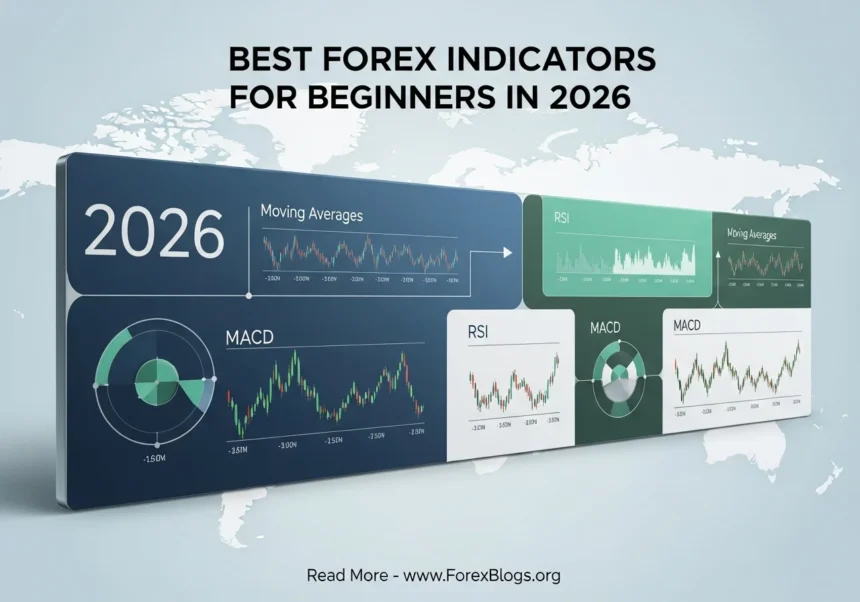
Ever opened a trading chart and felt like you were staring directly into the Matrix? Don’t worry, you aren’t the only one. When you’re just starting out, all those red and green candles jumping around can look like a totally foreign language. Best Forex Indicators for Beginners in 2026
- What Are the Best Forex Indicators Anyway?
- Step-by-Step Guide to Trading with the Best Forex Indicators
- Step 1: Find the main trend with Moving Averages (MA)
- Step 2: Catch the turns with the Relative Strength Index (RSI)
- Step 3: Measure the momentum using the MACD
- Step 4: See the volatility with Bollinger Bands
- Step 5: Find hidden levels with Fibonacci Retracement
- Step 6: Put it all together (The Confluence)
It can feel pretty overwhelming trying to figure out when to buy or sell just by looking at a blank screen. That’s exactly where finding the best forex indicators comes into play.
Think of them as your training wheels while you learn how the currency market actually moves. Let’s break down the top ones for 2026, step by step, minus all that confusing Wall Street jargon.
What Are the Best Forex Indicators Anyway?
Let’s keep this super simple. A forex indicator is basically just a math formula working behind the scenes. It looks at past price and volume data, crunches the numbers, and turns that messy history into a clean visual line or graph.
Think of it like driving a car. When you drive, you look out the windshield to see the road ahead. In trading, looking at the road is like looking at raw “price action.” You can see the hills and the curves.
But you also have a dashboard, right? You occasionally glance down to check your speedometer, or to see if you’re about to run out of gas. Indicators are your trading dashboard.
They won’t steer the car for you, and they definitely can’t predict the future with 100% accuracy. But they give you massive clues about whether the market is speeding up, slowing down, or completely running out of fuel.
Step-by-Step Guide to Trading with the Best Forex Indicators
Okay, so you’ve got your blank chart open. Now what? You don’t want to just slap a bunch of random tools on there and hope for the best.
Instead, we are going to build a solid beginner strategy. Here’s a step-by-step guide to setting up and using the most reliable tools in the game.
Step 1: Find the main trend with Moving Averages (MA)
You’ve probably heard the old trading rule, “the trend is your friend.” Well, moving averages are exactly how you find that friend.
A moving average takes the average price over a certain number of days and draws a smooth line directly on your chart. It cuts out all the confusing daily noise and shows you the true direction the currency is heading.
If the line is pointing up, you should probably be looking to buy. If it’s pointing down, you want to sell. It really is that straightforward.
Tip: For beginners, try putting a 50-period and a 200-period Moving Average on your chart. When the faster 50-line crosses above the slower 200-line, it’s often a strong sign that a big upward trend is starting.
Step 2: Catch the turns with the Relative Strength Index (RSI)
Now that you know which way the market is going, you need to know when to jump in. Enter the RSI.
This tool sits below your main chart and measures the speed of price movements on a scale from 0 to 100. It’s perfect for spotting when a currency pair has been pushed too far in one direction and needs a break.
Think of the market like a rubber band. If you stretch it too far up (an RSI reading over 70), it’s considered “overbought” and will likely snap back down. If you stretch it too far down (an RSI reading under 30), it’s “oversold” and due for a bounce higher.
Tip: Don’t blindly buy just because the RSI hits 30. Wait for the actual price candles to start turning around before you risk your money.
More Read

Step 3: Measure the momentum using the MACD
MACD stands for Moving Average Convergence Divergence. I know, it sounds like something out of a college physics textbook. But I promise it’s actually really easy to use.
The MACD also sits at the bottom of your screen. It looks like a little histogram (those vertical bars) with two lines weaving through it. It helps you see how much force or “juice” is behind a price move.
When the two lines cross over each other and start pointing up, momentum is building for the buyers. When they cross and point down, the sellers are taking control of the wheel.
Tip: The best trades usually happen when the MACD lines cross at the exact same time the histogram flips from red to green. It’s a great visual confirmation.
Step 4: See the volatility with Bollinger Bands
Markets aren’t always moving in straight lines. Sometimes they are dead quiet, and sometimes they are incredibly wild. Bollinger Bands help you see this volatility at a glance.
This indicator draws three lines: one right through the middle of the price, and two on the outside that act like a tunnel around the candles.
When the market gets super quiet, the outside bands squeeze tightly together. In forex, a tight squeeze almost always means a big, explosive move is right around the corner.
Tip: Watch out for the “bounce.” Prices love to bounce off the outer bands and head back toward the middle line. It’s a great place to take your profits if you’re already in a trade.
Step 5: Find hidden levels with Fibonacci Retracement
The name Fibonacci might sound a bit intimidating, but don’t panic. You don’t have to do any of the math yourself. Your trading platform will draw it for you.
Markets never go straight up or straight down. They move like a staircase. They push up, pull back a little to catch their breath, and then push up again.
You just drag the Fibonacci tool from the bottom of a move to the top. It will automatically draw horizontal lines on your screen. These lines show you exactly where the market is most likely to stop and catch its breath before continuing the trend.
Tip: The 50% and 61.8% levels are the magic numbers here. Watch those areas closely for a chance to join the trend at a huge discount.
Step 6: Put it all together (The Confluence)
The real secret to using the best forex indicators isn’t finding one magic tool. It’s about making them work together as a team.
Traders call this “confluence.” It basically means waiting for multiple indicators to tell you the exact same story before you hit the buy or sell button.
For example, let’s say the Moving Average says the trend is up. Then, the price pulls back to a Fibonacci level. Finally, the RSI drops down to 30 (oversold). That’s three different tools giving you the green light. That is what a high-probability trade looks like.
Common Mistakes When Using the Best Forex Indicators
Look, we all make mistakes when we first start trading. I definitely did my fair share of dumb things. To save you some time (and money), here are a few traps you need to avoid.
1. Creating a “Spaghetti Chart”
This is the number one newbie mistake. You discover indicators, get super excited, and suddenly your chart has 14 different lines on it. You can’t even see the actual price anymore! It looks like a bowl of colorful spaghetti. Keep it clean and stick to 2 or 3 indicators max.
2. Chasing the “Holy Grail”
Spoiler alert: there is no secret indicator that wins 100% of the time. If someone tries to sell you one on Instagram, run the other way. Accept that losing trades are just part of the business. Focus on managing your risk instead of hunting for a flawless tool.
3. Ignoring the actual price action
Indicators are amazing helpers, but price is the ultimate boss. If your indicator says “buy” but there’s a massive, aggressive red candle crashing down your screen, don’t buy! Always let the actual price confirm what your indicators are whispering.
4. Changing your settings every day
It’s super tempting to tweak the math on your MACD or RSI after a losing trade. You think, “Oh, if I just change this 14 to a 12, I would have won.” Don’t do this. Pick standard settings, stick with them, and learn how they behave over a long period.
5. Trading during crazy news events
When massive economic news drops (like US employment numbers or inflation data), indicators go completely out the window. The market moves way too fast for the math to keep up. It’s usually best to sit on your hands and wait for the dust to settle.
Frequently Asked Questions
Are forex indicators lagging?
Yes, pretty much all of them are. Because they are calculated using past price data, they will always be a little bit behind what is happening right this very second. That’s why you use them for confirmation, rather than treating them like a crystal ball.
How many indicators should I use at once?
Less is definitely more here. Try to stick to two or three that do totally different jobs. For example, use one for trend (like a Moving Average) and one for momentum (like the RSI). Using three different trend indicators at the same time will just confuse you.
Do professional traders actually use indicators?
Absolutely. While some pros trade completely “naked” charts (just looking at blank price action), many highly successful traders use a few select indicators. They rely on them to help spot entries, manage risk quickly, and take the emotion out of their trading.
Conclusion
Learning to trade currency can feel pretty overwhelming at first. But it gets a whole lot easier once you have the right tools in your toolkit.
Remember, the best forex indicators aren’t magic wands that will make you rich overnight. They are just there to help you make smarter, more educated guesses about where the market is heading next. Take your time, pick a couple from this list, and get comfortable with how they move.
Your best bet right now? Open up a free demo trading account. Throw a Moving Average and an RSI on your chart, and just watch how they react to the market for a few days. You’ve got this!
#Forex #ForexTrading #BestForexIndicators #TradingIndicators #DayTrading #TechnicalAnalysis #FXTrading #ForexForBeginners #TradingStrategy #ForexMarket #Investing2026 #CurrencyTrading #FinancialMarkets #TradingTips #ForexSignals