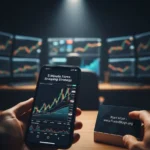



The first time I placed a trade from my phone, it felt slightly wrong. Like replying to a serious email with a thumbs-up emoji. The chart was there, the order ticket worked, the confirmation popped up. Still, I remember thinking, This can’t possibly be how people are supposed to do this. Mobile Trading vs Desktop Trading
Fast forward a few years, and I’ve closed positions from a grocery store aisle, adjusted stops while waiting for coffee, and watched markets move from a cracked phone screen more times than I can count. Desktop trading hasn’t disappeared from my life, not even close—but the relationship has changed. And that’s really what this debate is about. Not which one is “better,” but how each actually fits into real trading lives.
Let’s talk about that.
The Case for Mobile Trading – Mobile Trading vs Desktop Trading
Mobile trading is freedom. Plain and simple.
Markets don’t care where you are. They don’t pause because you stepped away from your desk or decided to live a little. Having a trading app in your pocket means you’re never fully disconnected, and for many traders—especially newer ones—that’s incredibly reassuring.
You can check positions in seconds. Adjust a stop. Close a trade before it turns ugly. No boot-up time, no desk, no ritual. Just tap, glance, act.
That immediacy is powerful. Sometimes too powerful.
Phones are built for speed and simplicity, which is great until it nudges you toward impulsive decisions. The screen is smaller. Context gets compressed. You see the candle that’s forming, not the broader structure it’s sitting inside. That’s where people get into trouble—overtrading, reacting instead of thinking.
Still, mobile trading shines for monitoring and execution. If you already know your plan, your levels, your risk, the phone becomes an extension of that plan. A tool, not a cockpit.
And yes, modern mobile platforms are far more capable than they used to be. Indicators, drawing tools, alerts—they’re all there now. Just… tighter. More constrained. You feel it after a while.
Why Desktop Trading Still Matters – Mobile Trading vs Desktop Trading
Desktop trading is where thinking happens.
There’s something about sitting down, opening a full platform, and seeing everything laid out properly. Multiple charts. Timeframes side by side. News feeds, depth of market, watchlists, execution panels—all visible, all alive at the same time.
That space matters. It slows you down in a good way.
Desktop setups encourage preparation. Analysis. Review. You’re less likely to jump into a trade just because a candle twitched. Instead, you’re seeing patterns unfold across hours or days, not seconds.
This is where strategies are built, tested, and refined. Where journaling happens. Where mistakes get replayed—sometimes painfully—and lessons stick.
For active day traders or anyone using complex strategies, desktop trading isn’t optional. It’s foundational. The precision, the control, the visibility—you simply can’t replicate that fully on a phone, no matter how polished the app is.
And let’s be honest: clicking a mouse or hitting a hotkey feels different than tapping glass. When size and speed matter, that difference counts.
More Read

It’s Not an Either-Or Choice
Here’s the quiet truth most people don’t say out loud: the best traders I know use both.
Desktop for planning. Mobile for managing.
They analyze markets in the morning on a proper setup. Identify levels, scenarios, invalidation points. Orders are placed deliberately, not hurriedly. Then they step away. Life happens.
When the market moves, the phone keeps them connected without dragging them back into analysis paralysis. Alerts fire. Decisions get executed. No panic, no scrambling to find a chair and a charger.
That balance matters more than the device itself.
Problems arise when people reverse the roles—using mobile trading to think and desktop trading to react. That’s when emotions sneak in and discipline starts slipping.
Beginners, Take Note – Mobile Trading vs Desktop Trading
If you’re new, this part matters.
Mobile trading feels accessible, and that’s good. But it can also mask how serious trading actually is. Swiping into positions like you’re scrolling social media sets the wrong tone from day one.
Learning on desktop first forces structure. You see how markets breathe. How messy they are. How rarely things line up perfectly. That grounding helps when you eventually move some execution to mobile.
Once you understand risk, position sizing, and patience, the phone becomes a convenience instead of a temptation.
So… Which One Wins?
Neither. And both.
Mobile trading wins on flexibility and speed. Desktop trading wins on depth and discipline. One keeps you connected. The other keeps you grounded.
If you had to choose only one, the answer would depend entirely on how you trade and who you are as a person. Some people need friction to stay disciplined. Others need access to stay calm.
The real edge comes from knowing yourself—and then choosing the tools that support that, not fight it.
Funny thing is, the longer you trade, the less this debate matters. You stop arguing platforms and start focusing on execution, risk, and consistency. The screens fade into the background. Decisions take center stage.
And that’s usually a sign you’re doing something right.