

Have you ever stared at a forex chart and felt like you were trying to read some sort of alien language? You’re definitely not alone. When you are trying to make rapid-fire trades—a popular style known as scalping—every single second counts, and a messy chart is the last thing you need. If you want to jump into the market, grab a few quick profits, and get out safely, you need the right tools for the job. Let’s break down the best technical indicators to help you spot those fast opportunities without losing your mind. Best Technical Indicators for Forex Scalping
What is Forex Scalping?
Before we start throwing charts and lines on your screen, let’s clear up what scalping actually is.
Imagine you’re at a massive buffet. Instead of sitting down for a heavy, three-course meal (which is like long-term investing), you just walk by, grab a single french fry, and keep moving. That’s scalping in a nutshell.
In the forex world, scalping means opening and closing trades within a matter of minutes, or sometimes even seconds. You aren’t trying to make $500 on a massive, week-long market swing. Instead, you’re looking to make tiny profits over and over again throughout the day. A scalper might take 10, 20, or even 30 trades in a single morning, just grabbing a tiny slice of the pie each time.
Because everything happens at lightning speed, you can’t just guess where the price of a currency pair is going. You need real-time data that you can actually understand at a glance. They act like the GPS in your car, telling you exactly when to hit the gas and when to hit the brakes. Without them, you’re just driving blindfolded.
Step-by-Step Guide: Setting Up the Best Technical Indicators
So, how do we actually set up a chart for fast trading? The secret is keeping it simple. You don’t need fifteen different lines crossing over each other. Here is a step-by-step guide to setting up and using the best technical indicators for your scalping strategy.
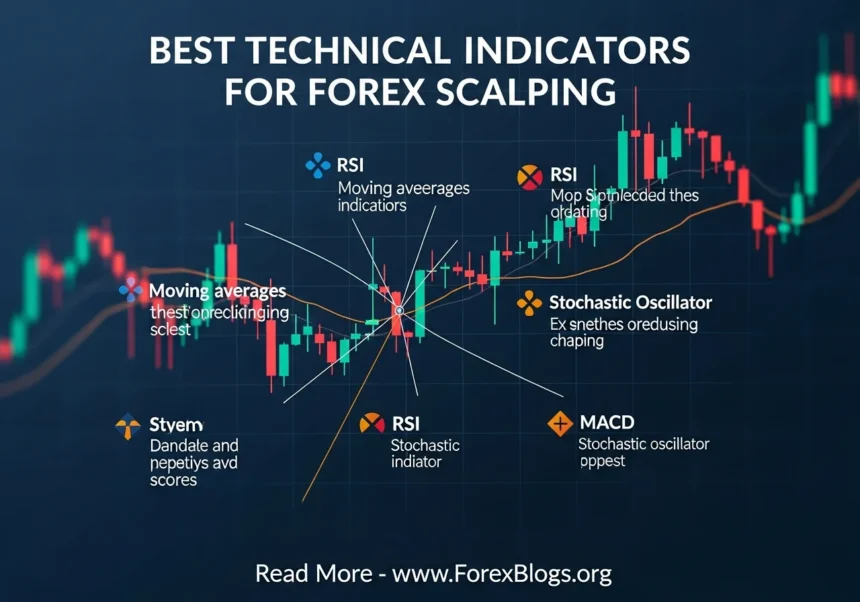
1. Add the Exponential Moving Average (EMA) for Trend Direction The EMA is basically the heartbeat of your chart. It tracks the average price of a currency pair over a certain amount of time, but it’s special because it reacts faster to recent price changes than a regular moving average. For scalping, speed is everything. Tip: Set up two EMAs on your 1-minute or 5-minute chart. Try a “fast” one (like the 9 EMA) and a “slow” one (like the 21 EMA). When the fast line crosses above the slow line, it’s a quick signal that the price might be shooting up.
2. Use the Relative Strength Index (RSI) to Find Momentum Okay, so the EMA tells you which way the wind is blowing. But does the move have any real power behind it? That’s where the RSI comes in handy. It’s a simple line at the bottom of your screen that bounces between 0 and 100. Tip: When the RSI goes above 70, the market is considered “overbought,” meaning buyers might be running out of energy. When it drops below 30, it’s “oversold,” meaning sellers are getting tired. As a scalper, you can use these zones to guess when the price is about to quickly bounce in the opposite direction.
3. Apply the Stochastic Oscillator for Perfect Timing The Stochastic indicator looks a lot like the RSI, but it’s a bit more sensitive to sudden price changes, making it one of the best technical indicators for timing your trades. It features two lines that cross over each other. Tip: Wait for both lines to drop below the 20 mark. When they cross upward, it’s often a solid signal to buy. It’s basically the chart’s way of telling you, “Hey, the quick drop is over, time to ride the bounce back up.”
4. Turn on Bollinger Bands to Measure Market Volatility Scalping is all about volatility. If the market isn’t moving, you aren’t making money. Bollinger Bands look like a little tunnel or a bubble wrapped around the price candles on your chart. Tip: When the market gets crazy, the bands widen. When it’s super quiet, they squeeze tightly together. A great scalping trick is to wait for the price to touch the bottom band during an overall uptrend—that’s usually a great spot to jump in for a quick buy before it bounces back to the middle.
5. Combine Them for a Complete Strategy Don’t use just one tool and ignore the rest. The magic happens when they agree with each other. For example, if your EMA shows an uptrend, your RSI is bouncing off the 30 level, and the price just hit the bottom Bollinger Band—that is a high-quality setup.
More Read

Common Scalping Mistakes to Avoid
Scalping can be incredibly fun and fast-paced, but it’s also really easy to mess up if you aren’t careful. Here are some of the most common mistakes beginners make, and how you can avoid them.
- Mistake 1: Creating a “Spaghetti Chart” It’s tempting to add every single indicator your trading platform offers. Don’t do it. If your chart looks like a bowl of colorful spaghetti and you can barely see the actual price, you have too much going on. Stick to two or three of the best technical indicators we talked about above. Keep your screen clean so your brain can process the information quickly.
- Mistake 2: Forgetting About the Spread The spread is the tiny fee your broker charges you for making a trade. When you are a long-term trader, a 2-pip spread doesn’t matter much. But when you are scalping and only trying to make 5 pips of profit, a 2-pip fee eats up almost half your money! Always trade currency pairs with super low spreads, like the EUR/USD or USD/JPY.
- Mistake 3: Revenge Trading After a Loss Because scalping is so fast, you will inevitably lose some trades. It happens to the best of us. The biggest mistake you can make is getting mad and immediately opening a bigger trade to “win your money back.” This is called revenge trading, and it’s the fastest way to blow up your account. Take a breath, step away for five minutes, and stick to your strategy.
- Mistake 4: Trading During the “Dead” Hours Scalping requires the market to be moving. If you try to scalp late at night when both the US and European markets are closed, the price will barely move. You’ll end up stuck in a trade for hours. The best time to scalp is usually during the overlap of the London and New York sessions (around 8 AM to 12 PM EST) when the market is highly active.
- Mistake 5: Ignoring the Bigger Picture Even if you are trading on a 1-minute chart, you still need to know what the 1-hour or 4-hour chart is doing. If the 1-hour chart is in a massive downward crash, you probably shouldn’t be looking for quick little buy signals on the 1-minute chart. Always trade in the direction of the bigger, overall trend.
FAQs About Forex Scalping
What is the best timeframe for forex scalping?
Most scalpers stick to the 1-minute (M1) or 5-minute (M5) charts. These lower timeframes give you the fastest updates on price action, allowing you to get in and out of the market quickly. Just remember, the lower the timeframe, the faster you need to make decisions.
How many indicators should I use at the same time?
Less is more! Try to use a maximum of two or three at once. For example, you might use one indicator for the trend (like the EMA) and one for momentum (like the RSI). Using more than three will usually just confuse you and give you conflicting signals.
Do I need a special broker for scalping?
Yes, you definitely want to choose a broker that is friendly to scalpers. You need a broker that offers very low spreads and fast execution speeds. If your broker’s platform lags for even two seconds when you click “buy,” it can ruin a scalping trade.
Conclusion
Diving into the world of fast-paced trading doesn’t have to be a stressful nightmare. By keeping your charts clean and relying on the best technical indicators, you can take a lot of the guesswork out of your day. Just remember that tools like the EMA, RSI, and Bollinger Bands are there to guide you, not to magically predict the future.
The best thing you can do right now is open up a free demo trading account. Slap a couple of these indicators on a 5-minute chart and just watch how they react to the price. Practice making a few quick trades with fake money until you get a feel for the rhythm of the market.
Have you tried using any of these indicators yet? Drop a comment below and let me know which one makes the most sense to you, or share this guide with a friend who is just starting their trading journey!
#ForexScalping #BestTechnicalIndicators #DayTrading #ForexTrading #TechnicalAnalysis #ForexStrategy #TradingIndicators #ScalpingStrategy #FinancialMarkets #FXTrading #TradingTips #MovingAverages #RSIIndicator #BollingerBands #PriceAction