

Ever stared at a trading chart and felt like you were looking at abstract art? You’re definitely not alone. When I first dipped my toes into trading, my screen was a chaotic mess of colorful lines, and honestly, I was still losing money. Forex Indicator Strategies That Win Consistently
The good news is you don’t need twenty different tools or a finance degree to make a profit. You just need a few reliable Forex indicator strategies that actually make sense to you. Let’s break down how you can stop guessing, clear up your charts, and start trading with confidence.
What are Forex Indicator Strategies?
To put it simply, an indicator is just a visual tool on your trading chart. It uses past price data to help you figure out where the market might go next.
Think of indicators like the dashboard in your car. You wouldn’t drive down the highway with your eyes closed or without checking your speedometer, right? Your dashboard gives you the info you need to drive safely. Indicators do the exact same thing for your trading account.
Building solid Forex indicator strategies just means combining one or two of these tools to give yourself a clear rulebook. Instead of buying because you have a “good feeling,” you buy because your indicators gave you a green light.
A quick real-life example: Let’s say you’re looking at a Moving Average. This is just a line that smooths out the price so you can see the overall direction. If the current price of the Euro crosses above that line, your strategy tells you it’s time to buy. If it crosses below, it’s time to sell. It really can be that straightforward.
Step-by-Step Guide: Creating Your First Winning Strategy
If you’re a beginner, the worst thing you can do is overcomplicate things. We are going to build a super simple strategy right now using just two basic tools.
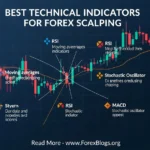
Step 1: Find the overall trend with a Moving Average First, you need to know which way the market is moving. The trend is your friend, as the old saying goes. Pull up a chart and add a 50-period Exponential Moving Average (EMA).
- If the price is above the 50 EMA line, we only want to buy.
- If the price is below the 50 EMA line, we only want to sell.
- Tip: Don’t try to fight the trend. If the line is pointing down, don’t look for reasons to buy.
Step 2: Pick a trigger indicator Now that we know the direction, we need to know exactly when to jump in. For this, we’ll use the Relative Strength Index (RSI). The RSI tells you if a currency is overbought (too expensive) or oversold (too cheap).
- The RSI has a scale from 0 to 100.
- When it drops below 30, the market is oversold.
- When it goes above 70, the market is overbought.
Step 3: Write down your entry rules This is where your Forex indicator strategies come to life. You need strict rules. Here is a perfect beginner setup for a “Buy” trade:
- The price must be above the 50 EMA (uptrend).
- The price pulls back and the RSI drops below 30 (oversold).
- When the RSI crosses back above 30, you hit the buy button.
- Tip: Write these rules on a sticky note and put it on your monitor. If a trade doesn’t meet all the rules, you don’t take it.
More Read

Step 4: Set your safety nets You will lose trades. It’s just part of the game. That’s why you always need a Stop Loss (an automatic exit if you lose too much) and a Take Profit (an automatic exit when you hit your goal).
- Place your Stop Loss just below the recent lowest price on your chart.
- Set your Take Profit to be at least twice as big as your Stop Loss. So, if you risk $10, your goal should be to make $20.
Step 5: Practice before you risk real money Don’t rush to deposit your hard-earned cash just yet. Open a free demo account with a broker. Trade this exact strategy 50 times with fake money.
- Tip: Treat the demo money like it’s real. If you can’t make a profit on a demo account, you definitely won’t make one with real cash.
Common Mistakes to Avoid with Forex Indicator Strategies
When you’re new, it’s super easy to fall into a few common traps. I’ve made every single one of these mistakes, so hopefully, you can learn from my bumps and bruises.
1. Cluttering your charts (Analysis Paralysis) You’ve probably seen those YouTube gurus with charts that look like a laser light show. They have ten different indicators, clouds, and grids. Don’t do this. More indicators don’t equal more money. They just give you conflicting signals and make you freeze up. Stick to two or three tools at most.
2. Strategy hopping after one loss This is a big one. You try a new strategy, take two trades, and they both lose. So, you immediately delete everything and look for a new strategy. Stop doing this! Even the best Forex indicator strategies have losing streaks. You need to test a strategy for at least 50 to 100 trades before deciding if it actually works.
3. Ignoring the bigger picture Let’s say you are trading on a 5-minute chart, and your indicators say “buy.” But if you zoom out to the 1-hour chart, the market is crashing hard. Always check a higher timeframe to see the overall weather before you step outside. If the 1-hour chart is in a downtrend, don’t buy on the 5-minute chart.
4. Chasing the “Holy Grail” indicator Spoiler alert: there is no magic indicator that wins 100% of the time. Stop wasting money buying secret software that promises guaranteed wins. The secret to consistent profits isn’t a magical line on a chart. It’s having a simple strategy, managing your risk, and having the discipline to follow your own rules.
5. Trading when the market is asleep Indicators need movement to work properly. If you try to trade during quiet times (like late evening in the US), your indicators will give you false signals. Stick to the busy times, like when the London and New York markets are both open.
Frequently Asked Questions
Which indicator is the best for beginners?
The Moving Average is easily the best starting point. It’s clean, easy to read, and immediately tells you if the market is going up or down. Pair it with an oscillator like the RSI or MACD, and you have a solid foundation.
Do Forex indicator strategies work all the time?
No, and anyone who tells you otherwise is lying. A good strategy might only win 50% to 60% of the time. The trick is making sure your winning trades are bigger than your losing trades. That’s how you grow an account.
Can I trade on my phone using these strategies?
You absolutely can, as most trading apps have built-in indicators. However, looking at charts on a tiny screen can be really tough when you’re just learning. Do yourself a favor and learn on a laptop or desktop first.
Conclusion
Learning to trade currencies doesn’t have to feel like learning a foreign language. The secret to winning consistently isn’t about being the smartest person in the room. It’s about keeping things incredibly simple.
Find a clean, easy-to-read setup. Write your rules down. Manage your risk like a professional, and most importantly, give yourself the grace to make a few mistakes along the way.
Ready to give it a shot? Go open a free demo account today, throw a Moving Average and an RSI on your chart, and see how it feels. You might just surprise yourself with how much sense it makes. Happy trading!
#ForexTrading #ForexStrategies #ForexIndicators #TechnicalAnalysis #DayTrading #TradingSignals #ForexMarket #FxTrading #TradingStrategy #CurrencyTrading #Investing #ForexProfit #FinancialMarkets #ForexEducation #PriceAction