

Stop looking for the magic indicator. Most retail traders spend their first two years plastering their charts with RSI, MACD, and a dozen different moving averages until the actual price bars are barely visible. It’s a mistake. Those indicators are lagging; they’re just mathematical echoes of what price has already done. If you want to trade the Forex market with any level of professional consistency, you have to learn to read the source code: Price Action. How to Use Price Action in Forex Day Trading
Price action is the study of how the exchange rate moves in real-time. It’s the rawest form of data we have. It reflects the collective psychology of every bank, hedge fund, and retail gambler in the world. When you strip away the noise, you start seeing the market for what it actually is—a never-ending battle between buyers and sellers.
The Foundation: Forget Lines, Think Zones – How to Use Price Action in Forex Day Trading
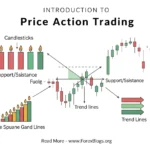
Most beginners treat support and resistance like they’re brick walls. They draw a thin line at 1.0850 and get frustrated when the price pokes through to 1.0845 before reversing. The market doesn’t care about your specific line.
Think in zones. Support and resistance are areas of high interest where the “memory” of the market resides. If the Euro bounced off a certain level three times last week, traders remember that. They’ve got orders sitting there. I look for the “scene of the crime”—the specific price point where a massive move started. When price returns to that area, I don’t just blindly click “buy.” I wait to see how the market reacts. Is it slowing down? Is it showing signs of exhaustion? That’s where the profit lives.
Reading the Candlesticks
A candlestick isn’t just a rectangle with some lines sticking out. It’s a story.
If you see a candle with a tiny body and a massive wick sticking out of the top, that’s rejection. It tells me that the buyers tried to push the price higher, but they ran into a wall of sellers who slapped them back down. I love these “pin bars” or “rejection candles.” They are the market’s way of saying, “We tried to go this way, and we can’t.”
Don’t trade every pin bar you see, though. Context is everything. A rejection candle in the middle of a messy range is just noise. But a rejection candle that happens right at a major historical resistance zone? That’s a signal I’m willing to put money behind.
More Read
Market Structure is Your Map
You’ve probably heard the cliché that the trend is your friend. It’s a cliché because it’s true, but most people misidentify the trend. I use market structure to stay on the right side of the move.
In an uptrend, I want to see a series of higher highs and higher lows. It’s like a staircase. If the market fails to make a new high and then breaks below the previous low, the staircase is broken. The trend has shifted. As a day trader, I’m not interested in picking the exact top or bottom. I want the “meat” of the move. I wait for the market to declare its intention, then I look for a way to join the flow.
The Art of the Pullback
I never buy a breakout. Let me repeat that: I don’t buy breakouts.
Most breakouts in the Forex market are “fakeouts.” Price surges past a level, traps all the impatient traders who are terrified of missing the move, and then immediately reverses. It’s a classic liquidity trap.
Instead, I wait for the pullback. If price breaks through resistance, I let it go. I wait for it to come back and test that same level from the other side. Yesterday’s ceiling becomes today’s floor. If price holds at that level and shows me a rejection candle, I’m in. It’s a lower-risk entry with a much clearer place to put my stop loss.
Risk is the Only Thing You Can Control
You’re going to be wrong. I’m wrong all the time. The difference between a professional price action trader and a frustrated amateur isn’t the win rate; it’s how they handle the losses.
I don’t care how “perfect” a setup looks. If the price action turns against me and hits my predetermined exit point, I’m out. No “giving it a little more room.” No “hoping it turns around.” Hope is not a strategy.
In day trading, you’re a risk manager first and a trader second. If you risk 1% of your account per trade and target a 2:1 reward-to-risk ratio, you can be wrong more than half the time and still grow your capital. Price action gives you the edge to find those high-probability setups, but your discipline is what keeps you in the game.
Final Thoughts – How to Use Price Action in Forex Day Trading
Trading price action requires patience. It’s boring. You’ll spend hours staring at a chart, waiting for price to reach your zone and give you the right signal. Most people can’t handle that. They feel the need to be “active,” so they take sub-par trades and wonder why their account is bleeding.
Stop chasing the market. Let the price come to you. Read the candles, respect the zones, and follow the structure. It’s not a get-rich-quick scheme; it’s a craft. Treat it like one.