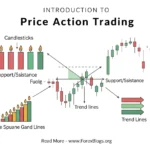



Scalping the forex market is often described as picking up pennies in front of a steamroller. It’s fast, it’s high-pressure, and if you aren’t precise, it’s a quick way to blow an account. Most retail traders fail because they clutter their screens with lagging indicators—RSIs, MACDs, and moving average crossovers that tell you what happened ten minutes ago when you need to know what’s happening now. Price Action Trading Guide for Forex Scalpers
If you want to survive as a scalper, you have to strip away the noise. You need to focus on price action.
Price action is the study of how the market moves, purely based on the historical and current price fluctuations. It’s the rawest form of data available. In the world of five-minute and one-minute charts, price action is your only real edge. Here is how I approach it.
The Foundation: Forget the Lines, Find the Zones – Price Action Trading Guide for Forex Scalpers
Most beginners draw support and resistance lines like they’re using a laser level. They expect the price to hit 1.0850 and bounce perfectly. It doesn’t work that way. The market is messy.
Think of support and resistance as zones or “thick” areas on the chart. When price approaches a previous high, it isn’t hitting a wall; it’s entering a battleground. Sellers are waiting there, but their orders are scattered. As a scalper, I’m looking for how the price reacts within these zones. Does it pierce through and get rejected quickly? Or does it stall, grinding sideways?
If you see price aggressively rejected from a zone with a long wick, that’s your first clue. The “why” matters less than the “what.” The “what” is that the big players are defending that level.
The Only Three Patterns You Actually Need
You don’t need to memorize a dictionary of seventy different candlestick patterns. For scalping, three are plenty. Anything more just creates analysis paralysis.
- The Pin Bar (Rejection): This is a candle with a long tail and a tiny body. It shows that the price tried to go somewhere and was violently pushed back. In scalping, a pin bar at a key zone is a clear signal that the momentum has shifted.
- The Engulfing Candle (Dominance): When a green candle completely swallows the previous red candle, the buyers have taken control. It’s a brute-force move. I look for these after a brief pullback to signal that the original trend is resuming.
- Inside Bars (Indecision): When a candle stays completely within the range of the previous one, the market is holding its breath. It’s a coil. When it breaks out of that range, the move is usually explosive.
More Read

The Context is the King
A pin bar in the middle of a sideways range is garbage. Don’t trade it.
I only care about these patterns when they occur at “confluence” points. This means the pattern is happening at a major horizontal level, or perhaps at a psychological round number like 1.1000.
Context also means understanding the “trend” on a slightly higher timeframe. If I’m scalping the 1-minute chart, I always have the 15-minute chart open. If the 15-minute trend is clearly up, I’m only looking for buy signals on my 1-minute chart. Trading against the larger flow is a recipe for getting stopped out by a sudden spike.
The Scalper’s Exit Strategy
This is where the math of trading either makes you or breaks you. Since we are looking for small moves, our stop losses have to be tight. But if they’re too tight, the natural “breathing” of the market will kick you out of a winning trade before it even starts.
I generally place my stop loss just behind the swing high or low of the signal candle. If I’m buying a pin bar, my stop goes a few pips below the wick.
As for profit, don’t be greedy. Scalping isn’t about catching 100-pip moves. It’s about high-probability 10-to-15 pip gains. I aim for a 1:1.5 or 1:2 risk-to-reward ratio. This means if I’m risking $50, I’m looking to make $75 or $100. If you try to hold for “the big one” while scalping, you’ll watch your profits evaporate more often than not.
The Psychological Grind – Price Action Trading Guide for Forex Scalpers
You have to be cold. You’ll have days where you take three losses in the first twenty minutes. The temptation to “revenge trade”—to double your position size to win it all back—will be overwhelming.
Don’t do it.
Price action trading requires a clear head. If the charts look like a mess and you can’t see a clear zone or a clean pattern, walk away. The market will be there tomorrow. Scalping is a game of high-volume, high-precision execution. If your nerves are frayed, your precision will slip, and the market will eat you alive.
Keep it simple. Watch the zones. Wait for the rejection. Get in, get your pips, and get out. That’s the only way to win.