


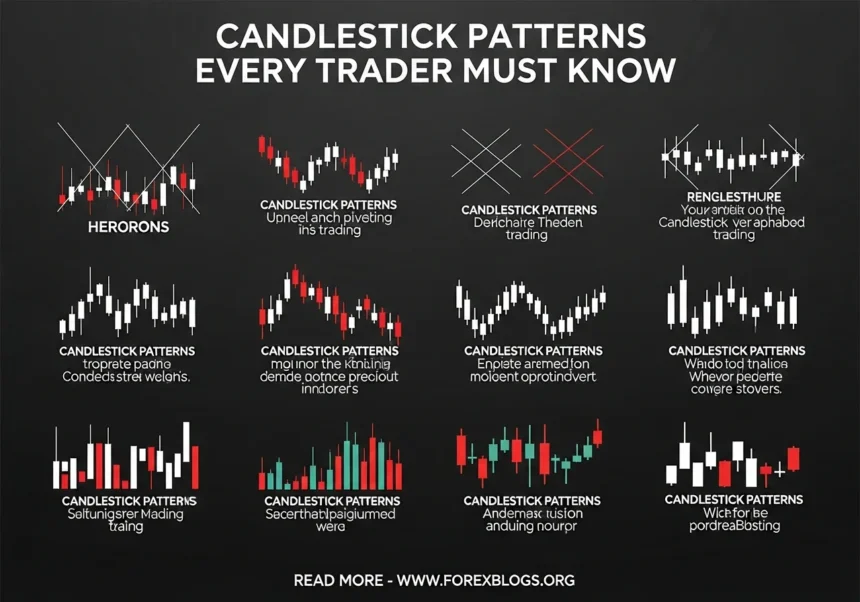
Have you ever opened up a trading app, looked at the flickering red and green bars, and felt like you were trying to decode a foreign language? You aren’t alone. It looks like a chaotic mess of lines at first, but once you understand the candlestick patterns every trader must know, that “mess” starts to look more like a map. These patterns are essentially the heartbeat of the market, showing you exactly who’s winning the tug-of-war between buyers and sellers.
- What are Candlestick Patterns Anyway?
- The Big Five: Patterns You’ll See Every Day
- 1. The Hammer (The “Bounce” Signal)
- 2. The Shooting Star (The Warning Sign)
- 3. The Engulfing Patterns (The Bully)
- 4. The Doji (The “I Don’t Know” Candle)
- 5. Morning and Evening Stars (The Three-Act Play)
- How to Actually Trade These Patterns
- Step 1: Look at the Big Picture
- Step 2: Identify the Pattern
- Step 3: Seek Confirmation
- Step 4: Set Your Safety Net (Stop Loss)
- 4 Common Mistakes to Avoid
- Frequently Asked Questions
- Which candlestick pattern is the most reliable?
- Do candlestick patterns work for crypto, stocks, and forex?
- How long should I wait for a pattern to “work”?
- Conclusion
What are Candlestick Patterns Anyway?
Think of a candlestick as a snapshot of time. Whether you’re looking at a 5-minute chart or a daily chart, each “candle” tells you four things: where the price started (open), where it ended (close), and the highest and lowest points it touched in between.
If the candle is green, it means the price went up. If it’s red, it went down. But the real magic is in the shape. The “body” (the thick part) and the “wicks” (the thin lines poking out the top and bottom) tell a story about investor psychology.
For example, imagine a stock starts at $10, drops to $8 because people got scared, but then buyers rushed in and pushed it all the way back up to close at $11. That struggle leaves a specific shape on the chart. By recognizing these shapes, you can get a pretty good idea of what might happen next.
The Big Five: Patterns You’ll See Every Day
You don’t need to memorize a thousand different formations to be successful. In fact, most pros focus on a handful of high-probability setups. Here are the core candlestick patterns every trader must know to get started.
1. The Hammer (The “Bounce” Signal)
The Hammer is a classic reversal pattern. It has a tiny body at the top and a long lower wick (the “handle”). It usually shows up after a price drop.
What’s happening here? Sellers were in control, pushing the price lower and lower. But then, buyers stepped in with a vengeance, driving the price back up near the opening level. It shows that the “bottom” might be in. If you see this at a support level, it’s often a sign that a rally is coming.
More Read
2. The Shooting Star (The Warning Sign)
This is the Hammer’s moody cousin. It has a small body at the bottom and a long upper wick. You’ll usually find this at the top of an uptrend.
What’s happening here? Buyers tried to push the price to the moon, but they ran out of steam. Sellers took over and slammed the price back down. It’s like the market is saying, “Okay, we’ve gone high enough for now.” It’s a classic signal that the trend might be about to flip downward.
3. The Engulfing Patterns (The Bully)
There are two types here: Bullish and Bearish. An engulfing pattern happens when one candle completely “swallows” the previous one.
- Bullish Engulfing: A small red candle is followed by a much larger green candle. It’s like a bigger wave overtaking a smaller one. It suggests the buyers have completely overpowered the sellers.
- Bearish Engulfing: A small green candle is followed by a massive red one. This tells you the sellers are now firmly in the driver’s seat.
4. The Doji (The “I Don’t Know” Candle)
A Doji looks like a cross or a plus sign. The opening and closing prices are almost exactly the same.
What’s happening here? It’s a total stalemate. Neither the bulls nor the bears could gain an inch. While a Doji doesn’t tell you to buy or sell immediately, it’s a huge “heads up” that the current trend is losing momentum. If you see a Doji after a long climb, be careful—the trend might be getting tired.
5. Morning and Evening Stars (The Three-Act Play)
These are three-candle patterns. A Morning Star starts with a big red candle, followed by a small, indecisive candle (like a Doji), and ends with a big green candle. It looks like the sun rising after a dark night. The Evening Star is the exact opposite and signals a potential drop.
How to Actually Trade These Patterns
Knowing what they look like is only half the battle. You have to know how to use them without losing your shirt. Here is a simple step-by-step process for using candlestick patterns in your daily routine.
Step 1: Look at the Big Picture
Don’t just hunt for a “Hammer” in the middle of nowhere. First, identify the trend. Is the market generally moving up or down? Patterns are much more reliable when they align with the overall direction of the market or occur at key price levels (like support and resistance).
Step 2: Identify the Pattern
Once the market hits a level you’re interested in, wait for the candle to close. This is the biggest mistake beginners make—they see a pattern forming and jump in before the candle is finished. A “Hammer” can easily turn into a “Big Red Bar” in the last thirty seconds of trading. Patience is your best friend here.
Step 3: Seek Confirmation
Never trade a candlestick pattern in isolation. Look for “confirmation” from other tools. For instance, if you see a Bullish Engulfing pattern, check if the trading volume is also high. High volume means a lot of people agree with that move, making it more likely to succeed.
Step 4: Set Your Safety Net (Stop Loss)
Even the most perfect-looking pattern can fail. If you’re buying because of a Hammer pattern, a smart place to put your stop-loss (the price where you’ll give up and exit) is just below the bottom of that candle’s wick. If the price drops below that, your “story” was wrong, and it’s time to get out.
4 Common Mistakes to Avoid
Even though these are some of the most important candlestick patterns every trader must know, beginners often trip up. Here’s what to watch out for:
- Ignoring the Context: A reversal pattern in a sideways, choppy market is usually just noise. Only take patterns seriously when they happen at significant price levels.
- Trading Small Timeframes: On a 1-minute chart, candles move so fast that patterns are often fake-outs. If you’re just starting, stick to the 4-hour or Daily charts. They are much “cleaner.”
- Expecting 100% Accuracy: Candlesticks aren’t a crystal ball. They represent probabilities, not guarantees. Sometimes a Shooting Star appears, and the price keeps going up anyway. That’s just part of the game.
- Over-complicating Things: You don’t need to know the names of all 50+ patterns. Stick to the main ones. If you try to track too many, you’ll get “analysis paralysis” and never make a trade.
Frequently Asked Questions
Which candlestick pattern is the most reliable?
There isn’t one single “best” pattern, but many traders swear by the Engulfing pattern and the Hammer. These are high-conviction moves that clearly show a shift in power between buyers and sellers. However, reliability depends more on the location (support/resistance) than the shape itself.
Do candlestick patterns work for crypto, stocks, and forex?
Yes! That’s the beauty of them. Because candlestick patterns represent human psychology—fear, greed, and indecision—they work in any market where humans (and the bots we program) are buying and selling.
How long should I wait for a pattern to “work”?
It depends on the timeframe you’re trading. If you’re looking at a daily chart, the move might take a few days to play out. If you’re on a 15-minute chart, you might see the result within an hour. A good rule of thumb is to give the trade a few candles’ worth of time to move in your direction.
Conclusion
Learning to read the market through candles is one of the most rewarding skills you can pick up. It takes you from guessing what might happen to making educated decisions based on what is actually happening.
Start by opening a demo account or just looking at historical charts. See if you can spot a Hammer or a Shooting Star and then see what happened next. Don’t worry about being perfect right away. Like learning to ride a bike, it feels clunky at first, but soon you’ll be scanning charts and spotting these setups in seconds.
The next time you look at a chart, remember: every candle is a story. Your job is just to listen. Happy trading!
#CandlestickPatterns #TradingStrategy #TechnicalAnalysis #StockMarket #DayTrading #CryptoTrading #ForexTrading #PriceAction #TradingTips #MarketAnalysis #InvestmentEducation #FinancialMarkets #ChartPatterns #BeginnerTrader #TradingPsychology










I stumbled upon this platform by chance and now I cannot imagine playing anywhere else. The promotions are straightforward and the games load super quickly even on mobile. A friend told me about it and I just wanted to pass along the info so visit bd99988 and start your journey.