

Have you ever stared at a trading chart, watching a trade go deep into the red, and felt your heart start pounding in your chest? How Emotions Affect Forex Trading. You’re definitely not alone.
When you first start forex trading, it feels like it’s all about learning chart patterns, analyzing numbers, and finding the perfect strategy. But honestly? The biggest battle you’ll face isn’t against the market—it’s against your own brain.
Let’s talk about why your feelings are probably messing with your profits right now, and how you can actually fix it.
What Exactly is Trading Psychology in Forex Trading?
Trading psychology is basically how your mindset and your emotions drive your decisions when you’re buying and selling currencies.
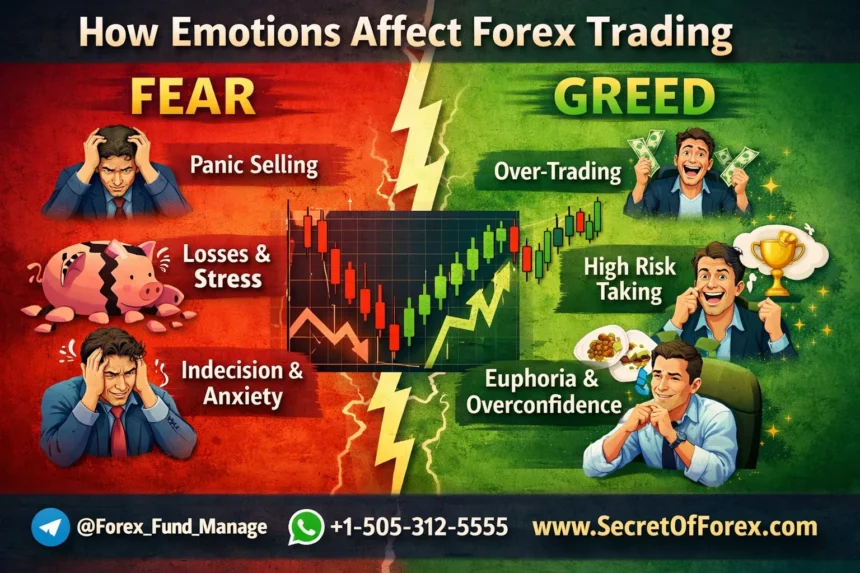
When we talk about the mental side of forex trading, we’re really dealing with two main troublemakers: fear and greed.
Imagine you’re at a casino. You just won a couple of hands of blackjack, and suddenly you feel totally invincible. You decide to bet your entire stack on the next hand because you just know you’re going to win.
That right there is greed. And it happens in the currency markets all the time. Traders get a taste of winning, ignore their risk limits, and end up blowing their accounts.
On the flip side, maybe you’ve lost three trades in a row. You’re scared of losing even more money, so you close your fourth trade early just to feel safe—even though your strategy said to hold on. That’s fear talking.
Both of these emotions make you abandon your logical plan and do things on pure impulse. Human brains are actually wired to hate losing. Psychologists call it “loss aversion.” It means the pain of losing $50 feels way stronger than the joy of making $50.
If you don’t get a grip on these natural instincts, even the best trading strategy in the world won’t save your account balance.
A Step-by-Step Guide to Controlling Your Emotions While Trading
So, how do you stop your feelings from hijacking your trades? It takes some practice, but you can absolutely train your brain to stay calm.
Here is a step-by-step approach to keeping cool under pressure.
Step 1: Trade with Money You Can Actually Afford to Lose This is the golden rule of investing. If you’re trading with your rent money, your car payment, or your grocery budget, you are going to be terrified of losing it.
That intense fear will make you second-guess every single move. You’ll exit good trades too early and panic when the price drops even a little bit.
Start with a small amount. If losing that money won’t change your daily lifestyle, you’ll immediately trade with a clearer, calmer head.
Quick tip: Open a demo account first. It uses fake money, so you can get used to the mechanics of the market without the wild emotional rollercoaster.
Step 2: Create a Bulletproof Trading Plan (And Stick to It) A trading plan is like a roadmap for your money. If you don’t have one, you’re not trading—you’re just guessing.
Your plan should lay out exactly when you’ll enter a trade, when you’ll take your profits, and when you’ll cut your losses. It should also include how much of your account you are willing to risk per trade (usually 1% or 2%).
When you have a strict set of rules, you don’t have to make tough decisions in the heat of the moment. You just follow the plan.
Quick tip: Write your specific entry rules on a sticky note and put it right on your monitor. If a setup doesn’t meet your rules, don’t click the buy button.
More Read

Step 3: Always Use a Stop-Loss A stop-loss is an automatic order that closes your trade if the market goes against you by a certain amount.
Think of it as your safety net. If you don’t use one, you might sit there watching a bad trade drain your account, blindly hoping it will magically turn around. Spoiler alert: it usually doesn’t.
Setting a stop-loss takes the emotion out of taking a loss. You accept the risk upfront, and the computer does the hard part for you.
Step 4: Keep a Trading Journal This sounds a lot like homework, I know. But keeping a journal is an absolute game-changer for beginners.
After every single trade, write down why you took it and how you felt. Were you bored? Anxious? Overconfident because of a previous win?
Over time, you’ll start to see patterns. You might realize you always lose money when you trade right after waking up, or that you tend to make bad choices on Fridays. Once you see the pattern, you can fix it.
Step 5: Step Away from the Screen Staring at every single tick of a price chart will drive you crazy. Watching a candle turn green, then red, then green again is exhausting.
Once you’ve set your trade with a stop-loss and a take-profit order, get up and walk away. Go make a cup of coffee, walk the dog, or watch a show.
Micromanaging a trade almost always leads to panic-closing it too early. Let the market do its thing.
Common Emotional Mistakes in Forex Trading (And How to Avoid Them)
Even seasoned pros mess up sometimes. But as a beginner, knowing the common emotional traps can save you a lot of grief (and a lot of cash).
Here are the biggest mistakes to watch out for when you’re looking at the charts.
Mistake 1: The Dreaded “Revenge Trade” You just took a loss. It stings. So, what do you do? You immediately open a bigger trade to try and win that lost money back as fast as possible.
This is called revenge trading, and it’s basically financial self-sabotage.
When you trade out of anger or frustration, you aren’t thinking straight. You aren’t looking at technical analysis anymore. You’re just gambling.
How to avoid it: If you hit your daily loss limit, shut down your laptop. The market will still be there tomorrow. Take a breather and come back when you aren’t mad at the charts.
Mistake 2: FOMO (Fear of Missing Out) You see a massive green candle shooting up on the chart. It looks like everyone on the internet is making money on this move, so you jump in right at the top.
Then, almost instantly, the price drops. Sound familiar?
FOMO makes you buy when prices are already way too high, or sell when they’re already way too low. It makes you chase the market instead of waiting for the market to come to you.
How to avoid it: Accept that you will miss good setups. It’s just part of the game. Never chase a trade that has already left the station. Wait for the next bus.
Mistake 3: Getting Overconfident After a Winning Streak Winning feels awesome. But stringing together three or four wins can actually be really dangerous for a beginner.
You start feeling like a market genius. You increase your position size, ignore your risk management, and stop doing your usual chart analysis.
Then, one bad trade comes along and wipes out all your hard-earned profits in minutes.
How to avoid it: Stay humble. Remind yourself that a lucky winning streak doesn’t make you invincible. Always stick to your usual risk limits, no matter how good you feel.
Mistake 4: Moving Your Stop-Loss You set your stop-loss perfectly, but the price is getting awfully close to it. You don’t want to take the hit, so you move the stop-loss further down to avoid getting stopped out.
You tell yourself, “It just needs a little more room to breathe. It’ll turn around.”
Next thing you know, a small planned loss turns into a massive, account-crushing disaster.
How to avoid it: Treat your stop-loss like a solid brick wall. Once it’s set, never move it further into the negative. Take the small paper cut so you live to trade another day.
Mistake 5: Trading Because You’re Bored Sometimes the market is just flat. Nothing is moving, and your strategy isn’t giving you any clear signals.
But you want the thrill of being in a trade, so you force a bad setup just for the sake of doing something.
This is a classic rookie error. Trading shouldn’t be about entertainment; it should be about following a boring, repetitive process that makes money over time.
How to avoid it: If there are no good setups, do something else. Review your past trades, read a book on market analysis, or just take the day off. Sitting in cash is a valid, profitable position.
Frequently Asked Questions About Emotions and Currency Markets
Can I ever completely remove emotions from my trading? Honestly, no. You’re human, not a robot. You will always feel a little pinch when you lose money or a rush when you hit a big winner. The goal isn’t to stop feeling emotions completely. The real goal is to stop letting those feelings dictate your actions.
Why am I profitable on a demo account but losing money live? This is the ultimate proof that psychology matters! On a demo account, there is zero fear because the money isn’t real. You let winners run and cut losers easily. Once real money is on the line, fear and greed kick in, causing you to break your own rules.
How long does it take to master trading psychology? It varies for everyone, but expect it to take months or even years of consistent practice. It’s an ongoing journey. Even successful traders who have been at it for a decade still have to check themselves when they catch a bad losing streak.
Conclusion
Getting a handle on your mindset is arguably the hardest part of learning the ropes. You can memorize all the candlestick patterns in the world, but if you panic every time a trade goes south, you’ll really struggle to grow your account.
Just remember to take it slow. Stick to your trading plan, manage your risk properly, and be kind to yourself when you mess up. We all make silly emotional mistakes at first.
Why not start by reviewing your last few trades today? Take an honest look and see if fear or greed played a sneaky role in your decisions. Fixing those habits is the very first step to becoming a calmer, better trader.
Related Hashtags
ForexTrading #TradingPsychology #ForexTips #CurrencyTrading #FXMarket #TraderMindset #Investing #FinancialEducation #ForexSignals #TechnicalAnalysis #RiskManagement #ForexMentor #TradingStrategy #DayTrading #MarketInsights