

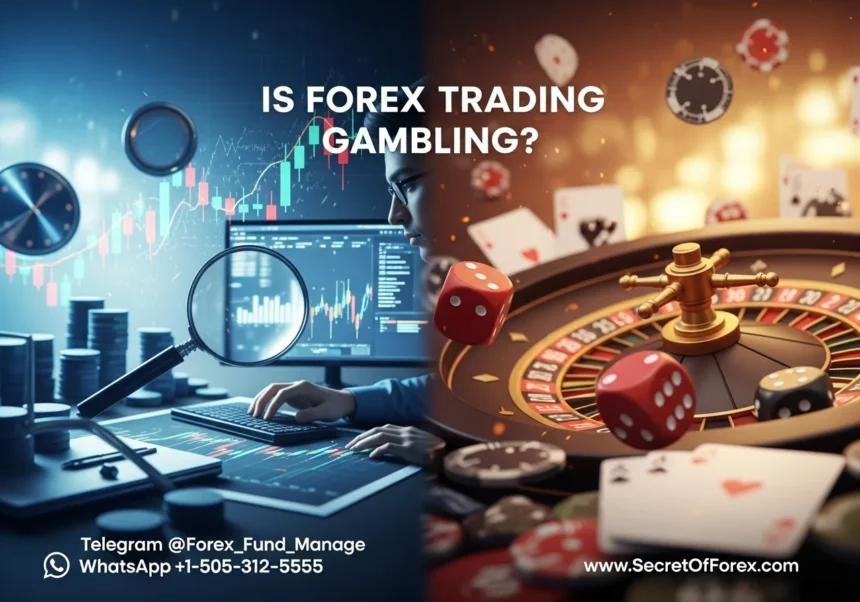
Ever placed a trade and felt your heart pounding like you just bet all your chips on red at a roulette table? Is Forex Trading Gambling ?
- What Exactly is Forex Trading? (And Why It Feels Like a Casino)
- Step-by-Step Guide to Stop Gambling and Start Forex Trading
- 1. Build a strict trading plan
- 2. Learn to manage your risk properly
- 3. Always use a stop-loss order
- 4. Keep a detailed trading journal
- 5. Master your own emotions
- 5 Common Mistakes That Turn Currency Trading Into a Casino
- 1. Using way too much leverage
- 2. Trading based on “gut feelings”
- 3. Staring at the 1-minute charts all day
- 4. Following random gurus on social media
- 5. Trying to get rich quick
- Frequently Asked Questions About Forex Trading
- Conclusion
You’re definitely not alone. When you’re just starting out, watching those red and green candles bounce around on a screen can feel exactly like sitting in front of a giant slot machine.
So, is forex trading gambling? Honestly, the answer depends entirely on the person clicking the “buy” or “sell” button.
If you go in blind hoping to get rich overnight, yeah, you are basically at a casino. But if you have a solid plan, it’s a completely different ballgame. Let’s break down the real difference and how you can stay on the right side of the line.
What Exactly is Forex Trading? (And Why It Feels Like a Casino)
Before we figure out if it’s a game of luck, we need to understand what we’re actually doing.
In simple terms, foreign exchange (or forex) is just buying one currency while selling another. You’re trying to make a profit off the changing values between the two.
Here is a real-life example. Imagine you live in the US and take a vacation to Europe. You trade $1,000 for Euros. But you end up staying at your friend’s house and don’t spend a dime.
When you fly back home, you exchange those Euros back into US dollars. But while you were gone, the value of the Euro went up. Suddenly, your Euros are now worth $1,100. You just made a $100 profit simply because the exchange rate moved in your favor.
That is exactly what forex trading is, just done digitally on a much larger scale.
The Edge vs. Pure Luck
So why do so many people think it’s just betting? Mostly because of how easy it is to lose money if you don’t know what you’re doing.
Gambling is a game of pure chance. When you pull the lever on a slot machine, the odds are permanently stacked against you. The casino always has the edge over time.
Professional trading is more like being the casino. You use charts, historical data, and risk management to find setups that have a higher probability of winning. You won’t win every single time—no one does—but over 100 trades, your statistical edge makes you profitable.
If you don’t have an edge, and you’re just guessing where the price will go? Then yes, you are 100% gambling.
Step-by-Step Guide to Stop Gambling and Start Forex Trading
If you want to survive in the currency markets, you have to treat it like a boring, predictable business. It shouldn’t be a thrill ride.
Here is a simple step-by-step guide to help you trade like a professional instead of a hopeful gambler.
1. Build a strict trading plan
You wouldn’t start a business without a business plan, right? The same goes for the markets. You need a clear set of rules before you even think about putting real money on the line.
Your plan should outline exactly what currency pairs you trade, what time of day you look at the charts, and exactly what setup needs to happen before you enter a trade.
Tip: Write your trading plan down on a physical piece of paper and tape it next to your monitor. Read it out loud before you start your day.
2. Learn to manage your risk properly
This is the absolute biggest difference between a trader and a gambler. A gambler bets their whole paycheck hoping for a jackpot. A trader only risks a tiny fraction of their account on any single idea.
A great rule of thumb is to never risk more than 1% or 2% of your total trading account on one single trade. If you have a $1,000 account, you should only be risking $10 to $20 per trade.
Tip: Use a position size calculator (you can find free ones online) before every trade to figure out exactly how much you are risking.
More Read

3. Always use a stop-loss order
A stop-loss is an automatic order that closes your trade if the market moves against you by a certain amount. It is your safety net.
Trading without a stop-loss is like driving a car down the highway without brakes. Eventually, you are going to crash. Gamblers hate stop-losses because they hold onto losing trades, hoping the price will magically turn around.
Tip: Place your stop-loss at the exact moment you enter the trade. Never move it further away just because you are scared of taking a small loss.
4. Keep a detailed trading journal
You can’t improve what you don’t measure. If you are just randomly clicking buttons, you’ll never figure out what works and what doesn’t.
Keep a spreadsheet or a notebook. Every time you take a trade, write down the date, the currency pair, why you entered, and what the final result was. Over time, you’ll start seeing patterns in your own behavior.
Tip: Take screenshots of your charts when you enter and exit a trade. Reviewing these on the weekend is a massive cheat code for getting better.
5. Master your own emotions
The market doesn’t care about your feelings. It doesn’t know if you had a bad day at work or if you really need to make rent this month.
When you trade with money you can’t afford to lose, fear and greed take over. You start making stupid decisions. You start revenge trading (trying to quickly win back money you just lost). That is pure casino behavior.
Tip: If you take two losses in a row, close your laptop and walk away for the day. The market will still be there tomorrow.
5 Common Mistakes That Turn Currency Trading Into a Casino
Even if you have the best intentions, it’s really easy to slip into bad habits. Here are a few common traps that beginners fall into that instantly turn their trading into gambling.
1. Using way too much leverage
Leverage is basically borrowed money from your broker that lets you control larger positions. It sounds awesome until you realize it multiplies your losses just as fast as your profits.
Brokers might offer you 100:1 or even 500:1 leverage. Using that much power as a beginner is financial suicide. Keep your leverage low until you actually know what you are doing.
2. Trading based on “gut feelings”
“I just have a feeling the US Dollar is going to drop today.”
If you ever catch yourself saying something like this, step away from the keyboard. The market doesn’t run on gut feelings. It runs on data, economic news, and mass human psychology. If you can’t point to a specific reason on the chart for your trade, you are guessing.
3. Staring at the 1-minute charts all day
When you watch the 1-minute or 5-minute charts, every tiny bump looks like a massive market crash. It creates a ton of fake signals and makes you panic.
Beginners should zoom out. Look at the 4-hour or daily charts. The trends are much clearer, the moves are smoother, and you won’t feel the urge to jump in and out of trades every ten seconds.
4. Following random gurus on social media
Instagram and TikTok are full of people showing off rented Lamborghinis, claiming they made thousands of dollars in ten minutes.
Copying random trade signals from a stranger on the internet is literally blindly betting. You don’t know their strategy, their risk tolerance, or if they are even trading a real account. Learn to read the charts yourself.
5. Trying to get rich quick
If your goal is to double your money in a week, you are going to blow up your account. Period.
Real trading is actually pretty boring. It’s about making slow, consistent percentages over months and years. It’s a marathon, not a sprint to the finish line.
Frequently Asked Questions About Forex Trading
Can you get rich quick with forex? No. This is probably the biggest myth out there. While there is a lot of money to be made, it takes months or even years of practice to become consistently profitable. Anyone promising you fast, easy money is likely trying to sell you a scammy course.
Is currency trading actually legal? Yes, it is completely legal. The foreign exchange market is the largest financial market in the world, heavily used by major banks, huge corporations, and governments. Just make sure you use a regulated and trustworthy broker.
How much money do I need to start? You can actually start with zero dollars by opening a “demo account.” This lets you practice with fake money in the real live market. Once you are ready for real money, many brokers let you open an account with as little as $50 to $100.
Conclusion
At the end of the day, the market is just a tool. How you choose to use that tool is entirely up to you.
If you jump in without a plan, risk half your account on a single idea, and let your emotions drive the bus, then yes—forex trading is absolutely gambling. You might as well take your money to Vegas and have some fun with it.
But if you take the time to learn, manage your risk like a professional, and stick to a proven strategy, it becomes a legitimate skill. It takes patience, discipline, and a whole lot of practice.
If you’re curious to see how it works, don’t just throw your hard-earned cash at the screen. Go open a free demo account today. Spend a few weeks clicking buttons with fake money, test out a simple strategy, and see if you have what it takes to trade like a pro.
#ForexTrading #TradingEducation #ForexStrategy #FinancialMarkets #RiskManagement #TradingVsGambling #ForexAnalysis #DayTrading #InvestingTips #CurrencyTrading #ForexTrader #MarketInsights #TradingMindset #FinanceEducation #OnlineTrading