



Most people come to the foreign exchange market looking for a shortcut to wealth. They see the flashy charts, the promise of leverage, and the 24-hour accessibility, and they think they’ve found a gold mine. They haven’t. What they’ve found is one of the most liquid, aggressive, and unforgiving environments on the planet. Step-by-Step Forex Trading Plan for New Traders
- 1. The Infrastructure Phase – Step-by-Step Forex Trading Plan for New Traders
- 2. Narrow Your Focus
- 3. The Strategy: Keep It Simple
- 4. The Math of Survival (Risk Management) – Step-by-Step Forex Trading Plan for New Traders
- 5. The Demo Trap and the Transition
- 6. The Journal is Your Boss
- 7. Control the Ego – Step-by-Step Forex Trading Plan for New Traders
If you want to survive your first year—let alone turn a profit—you need a plan that relies on discipline rather than luck. Here is how you actually build a trading operation from the ground up.
1. The Infrastructure Phase – Step-by-Step Forex Trading Plan for New Traders
Before you ever click “buy” or “sell,” you need the right tools. This isn’t about buying five monitors or a high-end trading desk. It’s about your broker and your platform.
Choosing a broker is your first real test of risk management. If you pick a firm just because they offer 500:1 leverage and a “vibrant” (oops, let’s say “flashy”) bonus, you’re already losing. Look for regulation. You want a broker overseen by a top-tier authority like the FCA in the UK or the NFA in the United States. Check their spreads on the EUR/USD. If the cost of entering a trade is too high, your strategy will bleed out before it has a chance to work.
Once the account is set, pick a platform. MetaTrader 4 or 5 are the industry standards, but TradingView has become the go-to for charting. Get comfortable with the interface. You don’t want to be fumbling with buttons when the market starts moving.
2. Narrow Your Focus
The forex market is massive. You have majors, minors, and exotics. New traders often make the mistake of watching twenty different pairs. Don’t do that.
Start with two. The EUR/USD and the GBP/USD are good candidates because they have the highest liquidity and the lowest spreads. They behave differently, but they follow enough logic that a beginner can start to see patterns. When you watch just one or two pairs, you begin to understand their “personality.” You notice how they react to the London open or how they stall during the New York lunch hour. That familiarity is an asset you can’t get by jumping from pair to pair.
3. The Strategy: Keep It Simple
You’ll be tempted to overlay your charts with every indicator available. RSI, MACD, Bollinger Bands, Ichimoku Clouds—it’s easy to create a “rainbow” on your screen that tells you absolutely nothing. This is analysis paralysis.
Pick one method. Maybe it’s support and resistance levels. Maybe it’s trendline breaks. Whatever it is, it should be something you can explain to a ten-year-old in two minutes.
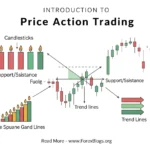
My advice? Focus on price action. Look at where the market has stopped and reversed in the past. These “zones” are where the big players have their orders sitting. Your job isn’t to predict the future; it’s to find a high-probability setup where the reward outweighs the risk.
More Read

4. The Math of Survival (Risk Management) – Step-by-Step Forex Trading Plan for New Traders
This is the only part of this plan that isn’t optional. If you ignore this, you will blow your account. It’s a mathematical certainty.
Never risk more than 1% of your total account balance on a single trade. If you have $10,000, you aren’t allowed to lose more than $100 on one position. This sounds small. It feels slow. But it’s the only way to stay in the game long enough to learn.
You also need to understand the Risk-to-Reward ratio. I tell my students that if they aren’t aiming for at least a 1:2 ratio, the trade isn’t worth taking. This means if you’re risking $100, your profit target should be at least $200. This math allows you to be wrong more than half the time and still make money.
5. The Demo Trap and the Transition
Everyone tells you to start with a demo account. They’re right, but only to a point. Use a demo account to learn how to execute trades, set stop losses, and read the charts. Spend a month there.
But don’t stay there.
Demo trading doesn’t involve real money, which means it doesn’t involve real emotion. You won’t feel the pit in your stomach when a trade goes against you, and you won’t feel the dangerous rush of adrenaline when you win. As soon as you have a grasp on the mechanics, move to a small live account. Trade “micros.” The stakes should be low enough that a loss won’t ruin your life, but high enough that it actually stings a little. That sting is where the real learning happens.
6. The Journal is Your Boss
If you don’t record your trades, you aren’t trading—you’re gambling. A professional trader keeps a log. You need to write down:
- Why you entered (the setup).
- Where you put your stop loss and why.
- How you felt during the trade.
- The outcome.
After a month, look back at the data. You’ll see patterns. You’ll realize you always lose money on Friday afternoons, or you’ll see that your “breakout” trades actually fail 70% of the time. This data is your only path to improvement. Without it, you’re just guessing.
7. Control the Ego – Step-by-Step Forex Trading Plan for New Traders
Trading is a psychological battle against yourself. Your brain is wired to do the wrong thing. When a trade is losing, your ego will tell you to move the stop loss “just a little further” to give it room to breathe. Don’t. When you’re on a winning streak, your ego will tell you you’re a genius and you should double your position size. Don’t do that either.
The market doesn’t care about your opinions, your bills, or your ego. It just is. Your goal is to be a machine. You wait for your setup, you execute, you manage the risk, and you move on to the next one.
Trading isn’t about being right. It’s about being disciplined when you’re wrong. Master that, and you might just make it.










Okay, CasinoMXJuegos? Haven’t tried it myself yet, but the talk is buzzing. If you’re into online casino games, scope out casinomxjuegos and tell me what you think. Maybe we can team up for some wins!