



Most novice traders approach the forex market like they’re trying to crack a secret code. They clutter their screens with dozen of colorful indicators—MACD, RSI, Bollinger Bands, and some “magic” trend-following tool they bought for $99. It’s a mess. When you look at a chart buried under all that math, you aren’t actually looking at the market. You’re looking at a distorted, lagging reflection of what already happened. How to Read Forex Charts Using Price Action
If you want to trade with the big players, you have to strip the junk away. You need to look at price action.
Price action is the study of how the market moves in its rawest form. It’s based on the belief that everything you need to know—economic data, central bank decisions, and geopolitical fear—is already baked into the price. The chart isn’t just a series of zig-zags. It’s a record of a psychological war between buyers and sellers. To read a chart using price action, you stop looking for signals and start looking for the story.
The Foundation: Candlesticks are Footprints – How to Read Forex Charts Using Price Action
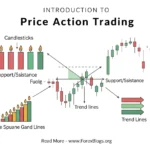
Every single candle on your chart tells a story of a battle. A candlestick isn’t just a price point; it’s a summary of who won and who lost over a specific period.
Look at the wicks. That’s where the real information lives. A long wick sticking out of the top of a candle tells me that the buyers tried to push the price higher, but they got slapped back down. The sellers won that round. If you see a cluster of long wicks at a certain price level, the market is screaming at you that it doesn’t want to go any higher. I don’t need a stochastic oscillator to tell me the market is “overbought.” The price is showing me that it’s hitting a ceiling.
The body of the candle matters just as much. A large, solid candle with almost no wicks shows pure momentum. It means one side is in total control. If you’re trying to sell into a massive, bullish candle, you’re essentially trying to stop a freight train with your bare hands. It’s a bad idea.
Market Structure is the Skeleton
Before you even think about entering a trade, you have to understand the market structure. The market only does three things: it goes up, it goes down, or it goes sideways.
An uptrend isn’t just a line. It’s a series of higher highs and higher lows. It sounds simple, but traders miss this constantly. If the market fails to make a new high and then breaks below the previous low, the trend is dead. It doesn’t matter what the news says. The structure has shifted.
More Read

I always tell people to zoom out. When you’re staring at a five-minute chart, every little flicker looks like a major move. It’s noise. Move to the daily or the four-hour chart. That’s where the “smart money” operates. When you see a clear structure on a higher timeframe, you’re looking at the true direction of the market. Everything else is just a distraction.
Support and Resistance Aren’t Magic Lines
One of the biggest mistakes I see is traders drawing dozens of thin, precise lines on their charts and expecting the price to bounce off them to the penny. The market isn’t that polite.
Think of support and resistance as zones, not lines. They’re areas where people have “memory.” If the price of EUR/USD hit 1.1000 and crashed three times in the last month, there’s a good chance sellers are waiting there again. It’s a psychological barrier.
When price approaches these zones, don’t just blindly click “sell.” Watch how it reacts. Is it slowing down? Are the candles getting smaller? Are you seeing those long rejection wicks I mentioned earlier? That’s your confirmation. Price action traders wait for the market to prove itself at these levels. We don’t guess; we react.
The Power of the Reversal Pattern
You don’t need to memorize fifty different candle patterns. You really only need to master a few that signify a shift in power.
The Pin Bar (or Hammer) is the king of price action. It’s a candle with a small body and a very long wick. It shows a sharp rejection of a price level. When a Pin Bar forms at a major resistance zone, it’s a clear signal that the sellers have taken over the narrative.
Then there’s the Engulfing pattern. This is when one candle completely “swallows” the previous one. It represents a total 180-degree turn in sentiment. It’s the market saying, “We tried going this way, but we’re going the other way now, and we’re doing it with conviction.”
Context Over Everything
Here is the secret that most “trading gurus” won’t tell you: a pattern by itself is worthless.
A Pin Bar in the middle of a messy, sideways market means nothing. It’s just noise. But a Pin Bar that forms right at a major historical support level during an overall uptrend? That’s a high-probability trade.
You have to weigh the evidence. Price action is about building a case. I look for “confluence”—where multiple factors line up. If the answer to all three is yes, the odds are in my favor.
The Reality Check – How to Read Forex Charts Using Price Action
Reading price action takes time. It’s a skill, not a formula. You’ll get it wrong sometimes. The market is a living thing, and it can be irrational. But by focusing on the price—the actual, raw data of the exchange—you’re miles ahead of the person waiting for two lines to cross on a lagging indicator.
Stop looking for the easy way out. Turn off the indicators. Open a clean chart. Start watching how the price moves, how it reacts to certain levels, and how the candles form. It’s the only way to truly understand the language of the market. It’s not about being right every time; it’s about reading the room and making an informed decision. That’s how professionals trade.









You suggested this fantastically.
Also visit my web-site: https://fintechbase.icu/