

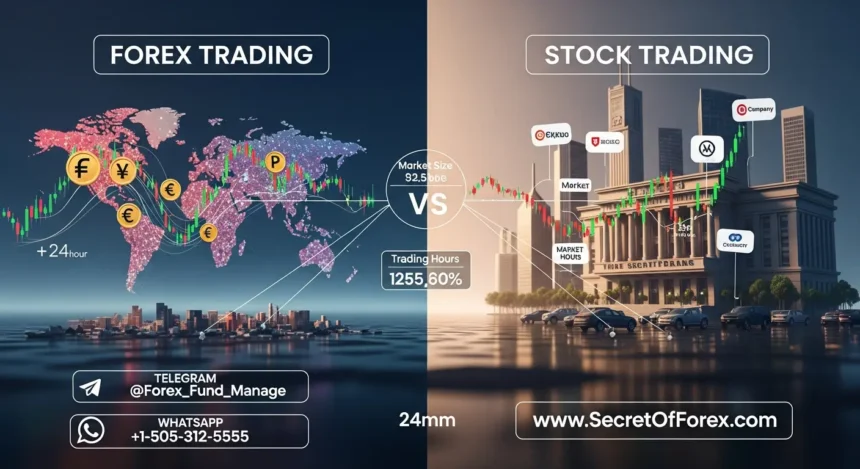
The first choice you have to make when you start trading is usually between two very different places: the stock market or the foreign exchange (Forex) market. Most beginners think of them as the same playgrounds where you buy low and sell high. That’s not right. Both can lead to profit, but the way they work, the risks involved, and the daily routines of these markets are very different. Forex Trading vs Stock Trading Key Differences
I’ve seen traders work their way through these waters for years, and I can tell you that your success often depends more on your personality than on your “talent.”
The clock never stops, except on the weekends – Forex Trading vs Stock Trading Key Differences
The schedule is the first thing you’ll notice that’s different. When you trade stocks, you have to follow the opening and closing bells of major exchanges like the NYSE and NASDAQ. At the end of the day, you get a clean break. For some, this is a good thing. Some people find it frustrating, especially when news breaks at 8:00 PM and you can’t do anything about it until the next morning.
Forex is a whole other thing. It is a global market that is not controlled by one person and is open 24 hours a day, five days a week. It follows the sun, going from Sydney to Tokyo, then London, and finally New York. It won’t stop. Forex lets you trade whenever you want, whether you’re a night owl or have a busy day job. But be careful: the market can go against you while you sleep because it works in 24-hour cycles. There is no “closing bell” to keep you safe from overnight changes.
Concentration vs. Dilution
You have a lot of options in the stock market, but that’s a double-edged sword. There are a lot of companies that are traded on the stock market. You can spend your whole life looking for the next “unicorn” among penny stocks, or you can stick to the big blue-chip companies. It needs a lot of filtering. You need to know how to read balance sheets, what happens when a CEO leaves, and how product cycles work.
The opposite is true for Forex. There are a lot of currency pairs, but most of the trading volume happens in the “majors,” which are pairs like EUR/USD, GBP/USD, and USD/JPY. You don’t have to look through thousands of choices. You focus on a small number of pairs instead and become an expert on the macroeconomic health of those areas. You’re not concerned about a company’s quarterly profits; you’re more concerned about interest rates, inflation, and stability in the world. The range is smaller, but the amount of knowledge needed is much greater.
More Read

The Leverage Trap
This is where the real-life business of trading gets tough. Forex is known for having high leverage. A lot of the time, brokers will give you 50:1 or even 100:1 leverage. This means that you can control $100,000 worth of currency with only $1,000 in your account. It sounds like a dream, but for people who don’t know what to expect, it’s a nightmare waiting to happen. When you use a lot of leverage, your gains are bigger, but a small price change in the wrong direction can wipe out your whole account in minutes.
In general, stock trading has much lower leverage, usually around 2:1 for most retail accounts. You’re putting more of your own skin on the line. This makes things go slower. It’s harder to get rich quickly in stocks, but it’s also much harder to lose everything in just one afternoon. If you have a gambling problem, Forex will find it and use it to its advantage. Stocks are for you if you want to build your wealth in a more controlled way. ### Liquidity and Execution Have you ever tried to sell a stock during a market crash? There isn’t always a buyer on the other side, though. That’s a problem with liquidity. There is a lot of difference in how liquid the stock market is for different companies. You can sell Apple stock right away, but a small-cap biotech company might leave you stuck.
Without a doubt, the Forex market is the most liquid financial market in the world. Every day, trillions of dollars move around. You can almost always buy and sell at the price you want because the volume is so high. The market is so big that the deal happens right away, without having to wait for a buyer to show up. This “tightness” makes Forex appealing to day traders who need to get in and out of trades quickly without losing money to wide spreads.
Owning vs. Guessing
Last but not least, we need to talk about what you really have in your hand. When you buy a stock, you own part of a company. You could get dividends. You have a right to assets. Over the long term, the stock market tends to go “up” because companies want to grow and come up with new ideas.
Forex isn’t an investment in the usual sense; it’s just a guess. You are betting that one currency will get stronger than another. It’s a game with no winners. Someone else loses when someone wins on a EUR/USD trade. Currencies don’t “grow” like businesses do; they just change value based on how strong or weak a country is compared to others.
Who Wins? – Forex Trading vs Stock Trading Key Differences
It’s not about which market is “better.” It’s about how you feel. If you like to learn about how companies work and have the patience to wait for stocks to grow, stick with them. Forex is the place for you if you like to think big and work in fast-paced, high-stakes situations. You can trade at 3:00 AM if you want to. Just don’t think it will be easy. If you don’t understand the little things that make each market work, they will both take your money.