

Have you ever noticed how the stock market seems to lose its mind every time the Federal Reserve meets? One day everything is green, and the next, a single sentence about “basis points” sends prices tumbling. If you’ve been wondering how interest rates influence stocks, you’re not alone. It’s one of the most important relationships in the investing world, yet it’s often wrapped in confusing jargon that makes most people want to tune out.
- What is Interest Rate Influence?
- How Interest Rates Influence Stocks: A Step-by-Step Breakdown
- 1. The Federal Reserve Makes a Move
- 2. The Cost of Borrowing Goes Up
- 3. Corporate Profits Take a Hit
- 4. Consumers Start Spending Less
- 5. Investors Look for “Safer” Bets
- How Interest Rates Influence Stocks for Different Sectors
- Tech and Growth Stocks (The Sensitive Ones)
- Banks and Financials (The Winners… Sometimes)
- Dividend Stocks and Utilities
- Why Understanding How Interest Rates Influence Stocks Matters for Your Portfolio
- Common Mistakes to Avoid When Rates Change
- FAQs About Interest Rates and Stocks
- Conclusion
What is Interest Rate Influence?
At its simplest, interest rates are the “price” of money. When you want to buy a house or a car but don’t have the cash, you “rent” that money from a bank. The interest rate is the rent you pay. Now, imagine this on a massive scale. When the government moves the needle on these rates, it changes the cost of doing business for every single company on the S&P 500.
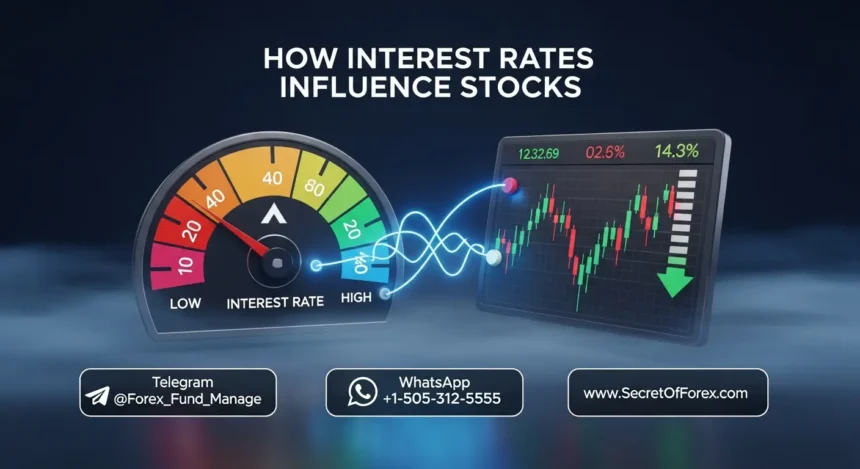
Think of it like a game of seesaw. Generally, when interest rates go up, the stock market feels a bit of downward pressure. When rates go down, it’s like giving the market a shot of espresso. For example, if you’re a local bakery owner and the interest rate on your business loan jumps from 4% to 8%, you might think twice about buying that second oven. That hesitation, multiplied by millions of businesses, is exactly how the economy slows down.
How Interest Rates Influence Stocks: A Step-by-Step Breakdown
It’s easy to say “rates go up, stocks go down,” but the actual process is a bit more like a domino effect. Here is exactly how the chain reaction happens in the real world.
1. The Federal Reserve Makes a Move
It all starts with the “Fed.” They don’t control every interest rate directly, but they set the “Federal Funds Rate.” This is the interest rate banks charge each other for overnight loans. When the Fed raises this rate, it becomes more expensive for your local bank to move money around.
2. The Cost of Borrowing Goes Up
Banks aren’t in the business of losing money, so they pass those costs on to us. Suddenly, your credit card interest rate ticks up, mortgage rates climb, and business loans get pricier. For a huge company like Apple or Amazon, which might borrow billions to build new warehouses or tech, this increase is a massive new expense.
3. Corporate Profits Take a Hit
This is the part that really scares investors. If a company has to spend more money just to pay back its debt, it has less money left over as profit. Since stock prices are largely driven by how much profit a company makes, lower profits usually lead to lower stock prices.
4. Consumers Start Spending Less
It’s not just the companies feeling the pinch; you feel it too. When your car payment or mortgage gets more expensive, you might decide to skip that new iPhone or wait another year to renovate the kitchen. When millions of people stop spending, companies sell fewer products, which further hurts their earnings.
5. Investors Look for “Safer” Bets
When interest rates are low, savings accounts and bonds pay almost nothing. You’re practically forced to put your money in stocks to get any kind of return. But when rates rise, “safe” investments like Treasury bonds start paying 4% or 5%. Many investors decide they’d rather take a guaranteed 5% from the government than risk their money in a volatile stock market. This shift in where money flows is a huge reason why stock prices drop.
How Interest Rates Influence Stocks for Different Sectors
Not all stocks are created equal when it comes to interest rates. Some thrive when rates are high, while others feel like they’re underwater.
Tech and Growth Stocks (The Sensitive Ones)
Tech companies often rely on “future earnings.” They might not be making much money today, but they promise big profits in ten years. When interest rates are high, the value of that future money is worth less in today’s dollars. This is why you often see the Nasdaq (which is tech-heavy) drop way faster than other indexes when rates go up.
Banks and Financials (The Winners… Sometimes)
Banks actually like higher interest rates—to a point. They can charge more for loans, which increases their “net interest margin” (the difference between what they pay you for your savings and what they charge for a loan). However, if rates get too high and people stop taking out loans altogether, the banks start to suffer too.
Dividend Stocks and Utilities
Companies like power plants or water companies are often seen as “bond proxies.” People buy them for their steady dividends. If a utility stock pays a 3% dividend but a safe government bond starts paying 5%, investors will dump the stock to buy the bond. This creates selling pressure on these traditionally “safe” sectors.
More Read

Why Understanding How Interest Rates Influence Stocks Matters for Your Portfolio
As a beginner, you don’t need to be an economist, but you do need to understand the “gravity” of interest rates. When rates are rising, the wind is blowing against your face. It doesn’t mean you can’t make money, but it means you have to be much more selective about which companies you own.
Low-interest-rate environments are often called “easy money” periods. This is when almost everything goes up because borrowing is cheap and there’s nowhere else to put cash. If you started investing between 2010 and 2021, you mostly lived through this “easy” mode. When rates finally started climbing in 2022, it was a wake-up call for many that the market doesn’t always go up in a straight line.
Common Mistakes to Avoid When Rates Change
Navigating a changing interest rate environment can be tricky. Here are a few traps beginners often fall into:
- Panic Selling: Just because the Fed raised rates doesn’t mean you should sell everything. The market often “prices in” these changes months in advance. By the time you hear the news, the drop might have already happened.
- Ignoring Debt Levels: When rates go up, companies with a lot of debt are in trouble. Always look at a company’s balance sheet. If they owe billions and rates are rising, they might struggle to pay the bills.
- Chasing High Yields: Don’t just look for the highest dividend. Sometimes a high dividend is a trap because the stock price is crashing due to interest rate pressure.
- Trying to Time the Fed: Professional traders spend millions trying to guess what the Fed will do next, and they still get it wrong. Don’t try to “beat” the news. Stick to your long-term plan.
- Forgetting Diversification: Since different sectors react differently to rates, having a mix of tech, healthcare, and financials can help balance your portfolio so one rate hike doesn’t ruin your whole month.
FAQs About Interest Rates and Stocks
Does the stock market always go down when interest rates go up? Not necessarily. While there is usually a “knee-jerk” reaction where stocks drop, the market can still go up if the economy is strong. If rates are rising because the economy is booming, companies might still make enough profit to offset the higher borrowing costs.
Why does the Fed raise interest rates anyway? Their main goal is to control inflation. When the economy gets too “hot” and prices for eggs, gas, and rent start rising too fast, the Fed raises rates to cool things down. They’re basically trying to make it a little harder to spend money so that prices stop climbing.
How long does it take for a rate change to affect the market? The stock market usually reacts instantly because investors are forward-looking. However, the “real” effect on the economy—like a company actually feeling the pain of a more expensive loan—can take 6 to 18 months to really show up in the data.
Conclusion
At the end of the day, understanding how interest rates influence stocks is about understanding the environment you’re playing in. You wouldn’t play a game of soccer without checking if the field was muddy or dry, right? Interest rates are the “field conditions” for investors.
Don’t let the headlines scare you. While high rates can make the market feel a bit bumpy, they are also a sign that the economy is being managed. The best thing you can do as a beginner is to keep a long-term perspective. Markets have survived interest rates of 1% and interest rates of 15%.
The key is to stay consistent, keep learning, and don’t let a single Fed meeting derail your financial goals. If you focus on buying high-quality companies that don’t over-rely on cheap debt, you’ll likely come out on top regardless of where interest rates head next.
Now that you know the basics, keep an eye on the next news cycle. You’ll start to see the patterns, and suddenly, those complex financial reports won’t seem so intimidating anymore!
#InterestRates #StockMarket #InfluenceStocks #Investing #FinanceTips #MarketAnalysis #StockTrading #InvestmentStrategy #EconomicTrends #FinancialEducation #WealthManagement #MonetaryPolicy #StockInvesting #MarketVolatility #PortfolioManagement