


Have you ever opened your trading platform, loaded up five different indicators, and felt like you were trying to land a spaceship instead of just placing a trade? I’ve been there. In my early days, my charts were so cluttered with colorful lines and flashing dots that I could barely see the actual price. It was exhausting. The truth is, the most successful traders I know don’t use fancy algorithms; they just look at the price. If you want to stop guessing and start understanding the market, mastering Forex Price Action Techniques for Swing Trading is the single best move you can make.
- What is Price Action Trading?
- Your Step-by-Step Guide to Forex Price Action Techniques for Swing Trading
- 1. Clean Your Charts
- 2. Identify the “Floor” and the “Ceiling”
- 3. Determine the Trend
- 4. Look for Your “Trigger” (The Candlestick)
- 5. Plan Your Exit Before You Enter
- Essential Forex Price Action Techniques for Swing Trading
- Common Mistakes Beginners Make
- FAQs
- Do I need expensive software for price action trading?
- What is the best timeframe for swing trading?
- How long does it take to learn price action?
- Conclusion
What is Price Action Trading?
At its heart, price action trading is about reading the “raw” movement of the market. Instead of relying on lagging indicators like RSI or MACD—which basically tell you what already happened—you’re looking at the actual footprints left by buyers and sellers. It’s like being a detective. You’re looking for clues in the candles to figure out who is winning the tug-of-war.
Think of it like shopping. If you see a crowd of people rushing into a store because there’s a massive sale, you don’t need a math formula to tell you that demand is high. Price action works the same way. When the price of a currency pair shoots up quickly with big, solid green candles, the “crowd” is buying.
For swing traders, this is gold. Swing trading is all about catching those medium-term moves—the “swings”—that last anywhere from a few days to a couple of weeks. By using price action, you can spot these moves before they happen and ride the wave without staring at your screen 24/7.
Your Step-by-Step Guide to Forex Price Action Techniques for Swing Trading
Ready to clean up those charts? Here is a simple, practical way to start using price action in your daily routine. Don’t worry about being perfect right away; it’s more about developing an “eye” for the market.
1. Clean Your Charts
The first thing you need to do is delete the noise. Get rid of the oscillators and the rainbows of moving averages. You want a “naked” chart. Most swing traders prefer the Daily or 4-hour timeframes because they filter out the “noise” of smaller timeframes. When you look at a clean chart, the story the market is telling becomes much clearer.
2. Identify the “Floor” and the “Ceiling”
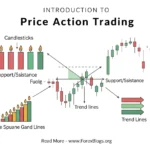
In trading terms, we call these Support and Resistance. These are the levels where the price has historically struggled to pass.
- Support (The Floor): A level where price drops to but bounces back up. Buyers think the price is “cheap” here.
- Resistance (The Ceiling): A level where the price rises to but falls back down. Sellers think the price is “expensive” here.
Pro Tip: Don’t draw these as thin lines. Think of them as “zones.” Price rarely hits a line to the exact pip; it usually lingers in an area before turning around.
3. Determine the Trend
You’ve heard the saying, “The trend is your friend,” right? It’s a cliché because it’s true. For swing trading, you want to be swimming with the current, not against it.
- Uptrend: You see higher highs and higher lows.
- Downtrend: You see lower highs and lower lows. If the chart looks like a messy zig-zag moving sideways, it’s a “ranging” market. If you’re a beginner, stay away from those until you’ve got more experience.
More Read

4. Look for Your “Trigger” (The Candlestick)
Once you know the trend and you’ve identified a key level (support or resistance), you need a reason to click “buy” or “sell.” This is where candlestick patterns come in. The most powerful ones for swing trading are:
- The Pin Bar: This candle has a long “tail” or “wick” and a small body. It shows that the price tried to go one way but got rejected hard. It’s a classic reversal signal.
- The Engulfing Bar: This is when a candle completely “eats” the previous candle. It shows a sudden, massive shift in momentum.
5. Plan Your Exit Before You Enter
This is where most beginners fail. Before you even open the trade, you must know where you’re getting out if you’re wrong (Stop Loss) and where you’re taking your profit (Take Profit). A good rule of thumb is to aim for a 1:2 risk-to-reward ratio. That means if you’re risking $50, you’re aiming to make $100.
Essential Forex Price Action Techniques for Swing Trading
To really get good at this, you need to understand the psychology behind the moves. Let’s look at a few techniques that will help you refine your entries.
The “Retest” Strategy
Market prices rarely move in a straight line. Often, when price breaks through a “ceiling” (resistance), it will come back down to touch that same level—which now becomes a “floor” (support)—before heading higher. This is called a break and retest. It is one of the most reliable ways to enter a swing trade because it gives you a clear place to put your stop loss.
Trading the “False Breakout”
Have you ever seen the price poke its head above a resistance level, only to crash back down immediately? This is often a “trap” for amateur traders. When you see a Pin Bar form right at a breakout point, it’s usually a sign that the big players are pushing the price back the other direction. Trading these “fake-outs” can be incredibly profitable because the move in the opposite direction is often very fast.
Confluence is Key
“Confluence” is just a fancy word for when multiple things line up. For example, if you see a Pin Bar (1) forming right at a major Support level (2) during an overall Uptrend (3), you have three reasons to take that trade. The more reasons you have, the higher the probability that the trade will work out.
Common Mistakes Beginners Make
Even with the best Forex Price Action Techniques for Swing Trading, you can still hit bumps in the road. Here are a few things to watch out for:
- Overtrading: Just because you’re a swing trader doesn’t mean you need to be in a trade every day. Sometimes the best position is no position. Wait for the high-quality setups.
- Revenge Trading: We’ve all been there. You lose a trade, you get angry, and you immediately jump back in to “get your money back.” This is a fast track to a zero balance. Take a walk, breathe, and stick to your plan.
- Ignoring Risk Management: You can be right 70% of the time, but if you don’t manage your risk, that 30% of losses will wipe you out. Never risk more than 1-2% of your account on a single trade.
- Chasing the Move: If you see a big green candle and you missed the entry, don’t jump in at the top. That’s FOMO (Fear Of Missing Out) talking. Wait for the price to pull back to a key level. The market will always provide another opportunity.
FAQs
Do I need expensive software for price action trading?
Not at all! That’s the beauty of it. Most free platforms like MetaTrader or TradingView have everything you need. You just need a clean candlestick chart and the ability to draw a few lines.
What is the best timeframe for swing trading?
Most swing traders live on the Daily (D1) and 4-hour (H4) charts. These timeframes give you a bird’s-eye view of the market and aren’t influenced by the “noise” of news events that happen on the 1-minute or 5-minute charts.
How long does it take to learn price action?
The basics can be learned in a weekend, but mastering it takes time and practice. It’s about building “screen time.” I usually suggest beginners spend at least a few months on a demo account practicing these techniques before using real money.
Conclusion
At the end of the day, trading should be about simplicity. By focusing on Forex Price Action Techniques for Swing Trading, you’re stripping away the confusion and looking at what actually matters: the price. It takes patience to wait for the right setup, and it takes discipline to stick to your risk rules, but the payoff is worth it.
Don’t feel pressured to learn every single candlestick pattern tonight. Start by finding support and resistance zones on your favorite currency pair. Watch how the price reacts when it hits those zones. Before you know it, those “random” movements on the chart will start looking like a clear map.
#SwingTrading #ForexTrading #PriceAction #ForexStrategy #TechnicalAnalysis #TradingTips #ForexEducation #FinancialMarkets #FXTrading #SwingTrader #PriceActionTrading #MarketAnalysis #TradingStrategy #ProfessionalTrading #ForexSignals