

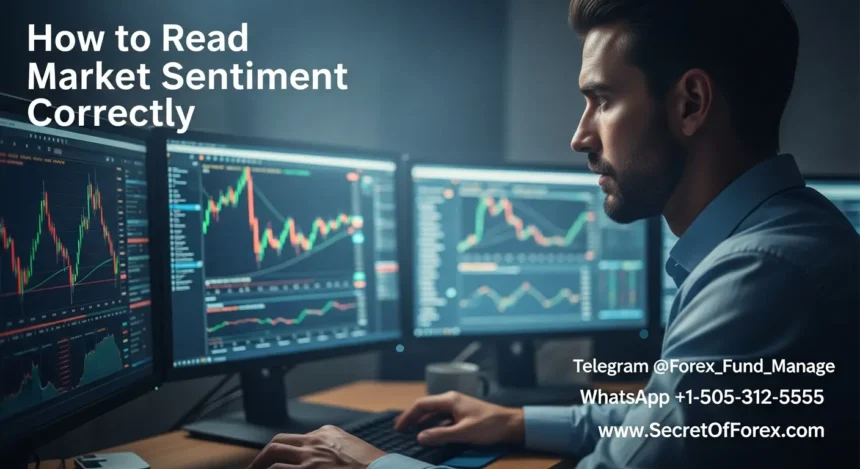
Have you ever looked at a stock chart and felt like the market was just doing its own thing, regardless of what the news said? Maybe a company reported record-breaking profits, but its stock price plummeted anyway. How to Read Market Sentiment Correctly. Or perhaps a company was hit with a massive lawsuit, and somehow, the stock price actually went up. It’s confusing, right? That’s because the market isn’t just a collection of numbers and spreadsheets—it’s a reflection of human emotions.
- What is Market Sentiment?
- A Beginner’s Guide on How to Read Market Sentiment Correctly
- 1. Check the “Fear Gauge” (The VIX)
- 2. Watch the Put/Call Ratio
- 3. Analyze the News vs. Price Action
- 4. Use the “Fear and Greed Index”
- 5. Follow Social Media (Cautiously!)
- Tips and Common Mistakes to Avoid
- FAQs
- Is market sentiment the same as fundamental analysis?
- Can I rely solely on sentiment to trade?
- Why does sentiment matter for beginners?
- Conclusion
Learning how to read market sentiment correctly is one of those skills that separates the people who just “gamble” on stocks from those who actually understand why prices move. It’s about getting a “vibe check” on the financial world to see if investors are feeling brave or if they’re hiding under their desks.
What is Market Sentiment?
At its simplest level, market sentiment is the collective attitude of investors toward a specific stock, sector, or the entire market. Think of it as the “mood” of the room. If everyone is optimistic and expects prices to go up, we call that a bullish sentiment. If everyone is scared and expects a crash, that’s a bearish sentiment.
I like to compare it to a house party. If you walk in and everyone is dancing and the music is loud, the “sentiment” is high energy and positive. If you walk in and everyone is sitting in small groups whispering with the lights dimmed, the sentiment is cautious or somber.
In the stock market, these moods drive buying and selling pressure. When people are greedy, they buy, and prices go up. When they’re fearful, they sell, and prices drop. A real-life example of this was the “Meme Stock” craze with GameStop. The company’s financials weren’t great, but the sentiment among retail investors was incredibly high, which pushed the price to astronomical levels.
A Beginner’s Guide on How to Read Market Sentiment Correctly
If you want to stop guessing and start understanding, you need a system. You don’t need a PhD in finance to do this; you just need to know which tools to look at and what they’re telling you. Here is a step-by-step approach to help you get started.
1. Check the “Fear Gauge” (The VIX)
The CBOE Volatility Index, or the VIX, is the most popular way to see how nervous investors are. When the VIX is low, it usually means investors are feeling confident and calm. When the VIX spikes, it means people are panicking. As a general rule, a VIX over 30 suggests high fear, while a VIX below 20 suggests a pretty relaxed market.
Pro Tip: Don’t just look at the number today; look at the trend. Is it climbing or falling?
More Read

2. Watch the Put/Call Ratio
This sounds technical, but it’s actually pretty straightforward. A “call” is a bet that a stock will go up, and a “put” is a bet that it will go down. By looking at the ratio of how many people are buying puts versus calls, you can see what the crowd is expecting. If the ratio is high (meaning more people are buying puts), the mood is bearish. If it’s low, everyone is feeling bullish.
3. Analyze the News vs. Price Action
This is my favorite way to gauge the “true” mood. Pay attention to how the market reacts to news. If a company releases bad news but the stock price barely moves or even goes up, that tells you the sentiment is incredibly strong—investors are “shrugging off” the bad stuff. On the flip side, if good news doesn’t push a stock higher, it might mean the sentiment has turned sour and people are looking for any excuse to sell.
4. Use the “Fear and Greed Index”
CNN Business has a tool called the Fear & Greed Index that aggregates several different factors into one easy-to-read needle. It ranges from “Extreme Fear” to “Extreme Greed.” For a beginner, this is a fantastic starting point. It’s a quick way to see if the market is getting a bit too over-excited or if it’s currently in a state of panic.
5. Follow Social Media (Cautiously!)
We live in a world where a single tweet or a Reddit thread can move billions of dollars. Checking platforms like X (formerly Twitter) or Stocktwits can give you a “boots on the ground” look at what regular people are saying. Just be careful here—social media is an echo chamber. If everyone is shouting about the same stock, the sentiment might be reaching a peak, which often leads to a reversal.
Tips and Common Mistakes to Avoid
Once you start learning how to read market sentiment correctly, it’s easy to get carried away. Here are a few things to keep in mind so you don’t fall into common traps.
- Don’t ignore the trend: Sentiment can stay “irrational” longer than you can stay solvent. Just because people are too greedy doesn’t mean the market will crash tomorrow. Sentiment tells you the mood, but the trend tells you the direction. Always look at both.
- Avoid confirmation bias: We all have a tendency to look for information that proves us right. If you love a certain stock, you’ll naturally look for bullish sentiment and ignore the people who are worried. Try to play devil’s advocate with yourself.
- The “Contrarian” Trap: There’s a famous saying: “Be fearful when others are greedy and greedy when others are fearful.” While this is great advice, beginners often try to be contrarians too early. Just because everyone is scared doesn’t mean you should buy immediately—the market can always go lower!
- Don’t overcomplicate it: You don’t need twenty different indicators. Pick two or three that you understand well (like the VIX and the Fear & Greed Index) and stick with them.
- Remember that sentiment is short-term: Market sentiment can change in an instant because of a single news headline. If you’re a long-term investor, don’t let daily sentiment swings scare you out of a good position.
FAQs
Is market sentiment the same as fundamental analysis?
No, they are very different. Fundamental analysis looks at things like earnings, debts, and revenue to find a stock’s “true value.” Market sentiment looks at how people feel about that stock. Sometimes a stock with great fundamentals has terrible sentiment, making it “undervalued.”
Can I rely solely on sentiment to trade?
I wouldn’t recommend it. While understanding the mood of the market is powerful, it’s best used alongside other tools like technical analysis (charts) or fundamental analysis. Think of sentiment as the “why” and technicals as the “when.”
Why does sentiment matter for beginners?
Because beginners often get caught up in the “hype.” By learning how to read market sentiment correctly, you can spot when a stock is being over-hyped by the crowd, which helps you avoid buying at the very top right before a drop.
Conclusion
At the end of the day, the stock market is just a giant group of humans making decisions based on hope, fear, and everything in between. Learning how to read market sentiment correctly isn’t about having a crystal ball; it’s about understanding the psychology of the crowd.
When you start paying attention to the VIX, the Put/Call ratio, and how prices react to news, you’ll start to see patterns you never noticed before. You’ll begin to realize that the market isn’t always rational—and that’s okay. In fact, that’s where the opportunities are.
Next time you see a stock jumping 10% for no reason, don’t just scratch your head. Look at the sentiment. See what people are saying, check the “fear gauges,” and try to feel the mood of the room. It takes a bit of practice, but once it clicks, you’ll see the charts in a whole new light. Happy hunting!
#MarketSentiment #TradingStrategy #StockMarket #ForexTrading #CryptoAnalysis #SentimentAnalysis #TechnicalAnalysis #InvestingTips #FinancialMarkets #TradingEducation #MarketPsychology #DayTrading #SwingTrading #InvestmentStrategy #MarketTrends