

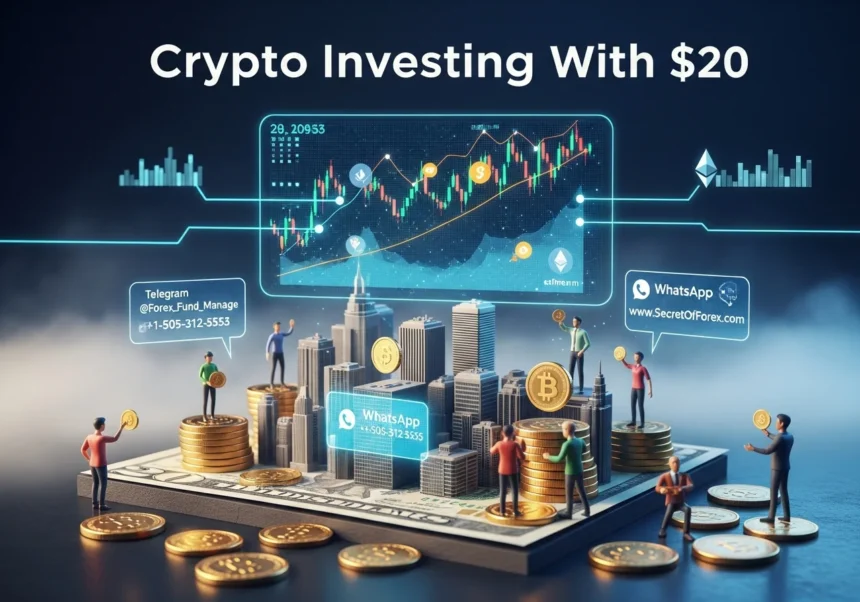
A lot of people think you need a lot of money to get into the digital asset market. They think they can’t get in because they see Bitcoin trading for tens of thousands of dollars. That’s not right. You don’t have to buy a whole coin. You can buy a part. Starting with just $20 is actually one of the best ways to learn the ropes without putting your finances at risk. Crypto Investing With $20
It’s about having something at stake. When you have money on the line, even if it’s just the cost of a bad lunch, you start to pay attention to the charts, the news, and the technology behind it all in a way that “paper trading” can’t.
The Trap of Fees – Crypto Investing With $20
If you’re starting with $20, your biggest enemy isn’t market volatility. It’s the fees.
If you use a regular store app and click “buy,” you might have to pay a flat fee of $1.50 or $2.00. That means you lose 10% of your $20 investment before the price even moves. You’re starting from a place that’s hard to get out of.
To avoid this, you should use the “Pro” or “Advanced” versions of big exchanges like Coinbase, Kraken, or Binance. These versions aren’t just for experts; they’re for anyone who doesn’t want to pay extra fees. Using limit orders instead of market orders can often lower the cost of your transaction to just a few cents. This keeps your $20 safe so it can really go toward the asset.
Where Should the Cash Go?
When you don’t have a lot of money, it’s easy to want to find the next “moonshot,” which are those strange coins with five zeros after the decimal point. Stay away from them. It might be tempting to think that your $20 could turn into $20,000 overnight if a meme coin takes off, but the truth is that 99% of those projects fail.
Stick with the blue chips.
More Read

The industry is built on Bitcoin and Ethereum. Yes, they are volatile, but they are backed by institutions and have real uses. You are basically buying a piece of the two most reliable networks in the space if you put $10 into Bitcoin and $10 into Ethereum. You won’t be a millionaire by Tuesday, but you’ll own assets that have done better than almost all other types of assets over a period of several years.
The “Micro-DCA” is a powerful tool.
The real magic of starting with $20 isn’t the first thing you buy. It’s the routine.
You can probably find $20 next month if you can find $20 this week. This is known as Dollar Cost Averaging (DCA). You don’t have to worry about whether the price is “too high” today if you put in small amounts at regular times. You are buying the average price over time. Your $20 buys more when the market goes down. When the market goes up, your $20 buys less, but your current investments become more valuable.
It’s a mechanical way to invest that takes the stress out of trying to time a market that never sleeps.
Security and Custody
People might shout, “Not your keys, not your coins.” They are telling you to take your cryptocurrency off of an exchange and put it in a private wallet.
The cold hard truth is that if you only have $20, you should keep it on the exchange.
You might have to pay $5 to $10 in network fees to move $20 of Bitcoin to a private hardware wallet. Once more, you’re wasting your money. For small amounts of money, a well-known, big exchange with two-factor authentication (use an app like Google Authenticator instead of SMS) is fine. You don’t need to worry about getting a hardware wallet and taking care of your own money until your portfolio is worth hundreds or thousands of dollars.
The Profit is the Education – Crypto Investing With $20
Don’t think of that $20 as a way to pay off your loan. Think of it as school fees.
There are a lot of technical terms, rules, and macroeconomics in the world of crypto. If you have a small stake, you should read the whitepapers, learn what a “Layer 2” is, and find out how global liquidity affects your holdings.
The capital gains from your first $20 won’t be the most valuable thing you get. It’s the ability to read and write about technology. We’re getting closer to a world where digital assets will be a big part of the global financial system. Getting used to the tools now, when the stakes are low, puts you way ahead of the people who will wait until the next big bull run to start asking questions.
Begin with small steps. Keep an eye on the fees. Don’t get caught up in the hype. It’s the only way to make a base that will last.