


If you walk into a professional trading floor, you won’t see screens covered in neon-colored lines or complex mathematical oscillators that look like a heart rate monitor. You’ll see clean charts. You’ll see price action. How to Read Forex Price Action Charts Like a Pro
Most retail traders fail because they’re trying to find a shortcut through indicators. They want a “buy” signal to pop up and do the thinking for them. It doesn’t work that way. I’ve spent years watching these markets, and I can tell you that the only thing that actually matters is what the price is doing right now, compared to what it did an hour, a day, or a month ago. Everything else is a derivative of that movement.
Reading a chart like a pro means learning to read the psychology of the crowd. It’s not math; it’s a story of greed, fear, and indecision.
Strip the Noise – How to Read Forex Price Action Charts Like a Pro
First, get rid of the junk. If you have five different indicators at the bottom of your screen, you’re suffering from analysis paralysis. When three say “buy” and two say “sell,” you do nothing. Or worse, you hesitate until the move is already over.
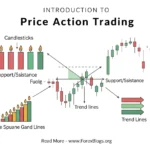
Professional price action trading starts with a naked chart. We use candlesticks because they tell us everything about the battle between buyers and sellers within a specific timeframe. A candle isn’t just a bar. It’s a footprint.
The Anatomy of Rejection
Look at the wicks. If you see a long wick sticking out of the top of a candle, that’s not just a line. That’s a failed attempt. Buyers tried to push the price higher, they got slapped down, and the sellers took control. We call this a rejection.
When you see a long lower wick at a major price level, the market is telling you it’s found a floor. It tried to break lower, couldn’t find any more sellers to keep the momentum going, and snapped back. These wicks are your most honest clues. They show you where the “big money” is sitting and waiting to defend their positions.
More Read

Stop Drawing Lines, Start Seeing Zones
Retail traders love drawing thin, exact lines on their charts. They’ll say, “Resistance is at 1.2500.” Then the price hits 1.2505, stops their trade out, and reverses.
The market doesn’t care about your specific line.
Price action is about zones. Think of support and resistance as thick rubber bands, not glass floors. A zone is an area where orders are clustered. I like to look for “confluence”—spots where a horizontal level meets a psychological round number or a previous peak. When the price enters these zones, I’m not looking to trade immediately. I’m waiting to see how the price reacts. Does it slice through like a hot knife through butter? Or does it start to stutter?
The Rhythm of Trends
Market structure is the backbone of everything we do. It’s remarkably simple, yet most people overthink it. A market in an uptrend makes higher highs and higher lows. A downtrend makes lower highs and lower lows.
It sounds basic. It is basic. But the trick is identifying when that rhythm breaks.
If a pair has been making higher highs for a week and suddenly fails to break the previous peak, the story has changed. The buyers are tired. I’m not going to blindly sell yet, but I’ve stopped looking for buys. This shift in structure—the transition from a steady trend to a messy range—is where most traders lose their shirts. They try to trend-trade a market that’s actually resting.
The Power of “Doing Nothing”
Here’s a hard truth: Pro traders spend about 90% of their time watching and 10% actually clicking buttons.
If the chart looks like a mess of sideways candles with no clear direction, stay out. You don’t have to be in the market every day. In fact, the more you trade, the more likely you are to make a mistake.
Wait for the “A+” setups. I’m looking for a clear trend, a pullback into a solid zone of support, and a rejection candle (like a pin bar or an engulfing pattern) to confirm that the buyers are stepping back in. If I don’t see all three, I go get a coffee. The market will still be there tomorrow.
Reading the Momentum – How to Read Forex Price Action Charts Like a Pro
You can feel momentum in the size of the candles. If you see five small green candles followed by one massive red candle that wipes out the gains of the previous four, that’s a massive red flag. That’s institutional selling.
Don’t fight that. Don’t try to be a hero and “buy the dip” when the momentum is clearly crashing against you. A pro trader follows the path of least resistance. We aren’t here to predict the future; we’re here to react to what’s happening in front of our eyes.
Reading price action is a skill that takes time to develop. You have to train your eyes to see the patterns in the chaos. Stop looking for the “holy grail” indicator. It’s not on the internet. It’s in the price. Learn to listen to what the candles are saying, and you’ll finally start seeing the charts for what they actually are: a map of human emotion.