

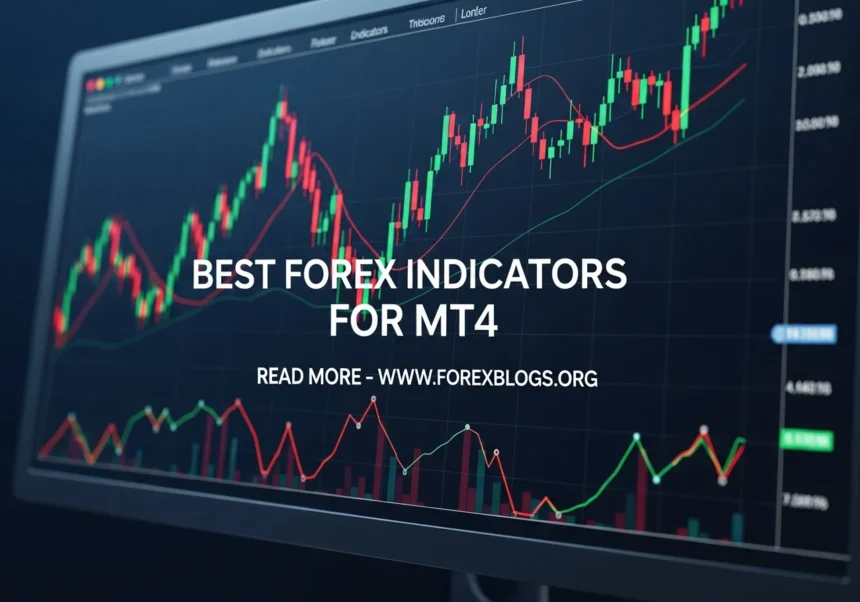
Ever stared at a Metatrader 4 chart and felt like you were looking at a heart rate monitor gone wrong? It’s a common feeling when you’re just starting out. You see red and blue lines zig-zagging everywhere and wonder how anyone actually makes sense of it. Finding the Best Forex Indicators for MT4 shouldn’t feel like you’re trying to crack a secret government code. It’s really just about finding the right tools to help you filter out the noise and see where the money is moving.
- What are these indicators anyway?
- A beginner’s guide to the Best Forex Indicators for MT4
- 1. Moving Averages (The Trend’s Best Friend)
- 2. Relative Strength Index (RSI)
- 3. MACD (Moving Average Convergence Divergence)
- 4. Bollinger Bands
- 5. Fibonacci Retracement
- How to set up your first indicator strategy
- Common Mistakes to Avoid
- FAQs
- Can I use these indicators on my phone?
- Which indicator is the most accurate?
- Are custom indicators better than the standard MT4 ones?
- Conclusion
What are these indicators anyway?
Think of a Forex indicator like the dashboard in your car. Your speedometer doesn’t drive the car for you, but it tells you if you’re going too fast or too slow. Indicators take historical price data—basically, what happened in the past—and run it through a math formula to show you a visual pattern.
For example, if you’re driving and the “low fuel” light comes on, you know it’s time to find a gas station. In trading, an indicator might show you that the market is “overbought,” which is just a fancy way of saying the price might be due for a dip soon. They don’t predict the future with 100% certainty, but they give you a much better “weather report” than just guessing.
A beginner’s guide to the Best Forex Indicators for MT4
If you open MT4 right now, you’ll see dozens of options. It’s tempting to throw all of them on your chart at once, but that’s a recipe for a headache. You only need a few solid ones to get started. Here are the heavy hitters that most successful traders keep in their toolkit.
1. Moving Averages (The Trend’s Best Friend)
The Moving Average (MA) is probably the most famous indicator out there. It takes the average price over a certain number of days and draws a smooth line on your chart.
- Simple Moving Average (SMA): This treats every day equally.
- Exponential Moving Average (EMA): This one cares more about what happened recently.
How to use it: If the price is above the line, the trend is generally up. If it’s below, the trend is down. It’s like a slope—don’t try to bike uphill if you don’t have to.
2. Relative Strength Index (RSI)
The RSI is what we call an “oscillator.” It moves back and forth between 0 and 100. It’s fantastic for telling you when a move has gone too far.
- Overbought (Above 70): The buyers are getting tired. Watch out for a drop.
- Oversold (Below 30): The sellers are exhausted. A bounce might be coming.
Imagine a rubber band. If you stretch it too far, it eventually wants to snap back. That’s what the RSI measures.
3. MACD (Moving Average Convergence Divergence)
I know, the name is a mouthful. Most traders just call it the “Mac-D.” This one is great for catching momentum. It looks like a bunch of bars (a histogram) and two lines crossing each other at the bottom of your screen.
When those lines cross, it’s often a signal that the direction of the market is changing. It’s like watching a runner start to slow down before they eventually turn around and head back the other way.
4. Bollinger Bands
These look like a “price envelope.” You have a middle line and two outer bands. When the market is quiet, the bands squeeze together. When things get crazy, they expand.
The cool thing about Bollinger Bands is that price tends to stay inside them most of the time. If the price touches the outer band, it’s like hitting a wall—it often bounces back toward the middle.
5. Fibonacci Retracement
While technically a drawing tool, it’s one of the Best Forex Indicators for MT4 because of how many people use it. It uses mathematical ratios found in nature to predict where a price might “pull back” before continuing its journey. It’s almost like a self-fulfilling prophecy because so many traders are looking at the same levels.
More Read

How to set up your first indicator strategy
Setting up a strategy isn’t about finding a “magic button.” It’s about creating a checklist. Here is a simple 5-step guide to getting your MT4 platform ready for action.
- Clean your slate: Start with a naked chart. Right-click your MT4 chart, go to “Properties,” and set a color scheme that doesn’t hurt your eyes.
- Pick your “Trend” indicator: Add a 50-period EMA. This will be your compass. If price is above it, you’re only looking for buy trades. If it’s below, you’re only looking to sell.
- Add a “Momentum” filter: Add the RSI (standard 14-period setting). Use this to make sure you aren’t buying right when the market is already “overbought.”
- Wait for the “Confluence”: This is a pro word for “things lining up.” Don’t just trade because one line moved. Wait for the price to be above your EMA and for the RSI to be coming up from the bottom.
- Test it on Demo: Before you put your hard-earned rent money on the line, use the MT4 demo account. See how these indicators behave during different times of the day (like the London or New York sessions).
Pro Tip: Don’t change the settings too much. The “default” settings are usually what everyone else is looking at, which makes them more effective.
Common Mistakes to Avoid
Even with the best tools, it’s easy to trip up. Here are a few things I see beginners do all the time:
- The “Indicator Soup” Problem: This is when you have 10 different indicators on your chart. You can’t even see the actual price candles anymore! If your chart looks like a Jackson Pollock painting, you’ve gone too far. Stick to 2 or 3.
- Chasing the “Holy Grail”: You might spend weeks looking for the perfect indicator that never loses. Spoiler alert: it doesn’t exist. Every indicator will give a “false signal” sometimes. That’s just part of the game.
- Ignoring the News: You can have the perfect indicator setup, but if the Federal Reserve is about to give a big speech, the technicals often go out the window. Always check an economic calendar.
- Trading without a Stop Loss: Indicators tell you where to enter, but you still need a plan for when you’re wrong. A stop loss is your emergency brake. Don’t drive without one.
- Changing your mind every 5 minutes: If you pick a strategy, give it at least 20-30 trades before you decide if it works or not. Jumping from one indicator to another every time you lose a trade is the fastest way to blow an account.
FAQs
Can I use these indicators on my phone?
Yes, the MT4 mobile app has most of the standard indicators like Moving Averages, RSI, and MACD. However, it’s a lot easier to do your “heavy lifting” analysis on a desktop computer where you can see the big picture, then use your phone to monitor the trade.
Which indicator is the most accurate?
There isn’t a single “most accurate” one. Moving Averages are great for trending markets (when the price is moving in one direction), while RSI and Bollinger Bands are better for “ranging” markets (when the price is bouncing between two levels). The best approach is to use one of each.
Are custom indicators better than the standard MT4 ones?
You’ll find thousands of custom indicators online, some even cost money. Honestly? Most of them are just tweaked versions of the standard ones. For a beginner, the built-in indicators are more than enough to become a profitable trader.
Conclusion
Learning the ropes in the Forex world takes time, but getting comfortable with the Best Forex Indicators for MT4 is a massive leap in the right direction. Remember, these tools are there to support your decisions, not make them for you. They help you stay objective when your emotions are telling you to panic.
Start slow. Pick one or two indicators that make sense to you, play around with them on a demo account, and see how they react to the market moves. Trading is a marathon, not a sprint, so don’t feel like you have to master everything by tomorrow morning.
Why not open up your MT4 platform right now and try adding a Simple Moving Average to a chart? See if you can spot where the trend changed. It’s the best way to learn!
#ForexIndicators #MT4 #BestForexIndicatorsForMT4 #ForexTrading #MetaTrader4 #TechnicalAnalysis #ForexStrategy #TradingIndicators #CurrencyTrading #FXTrading #AlgorithmicTrading #TradingSignals #ForexMarket #MT4Indicators #DayTradingTools