

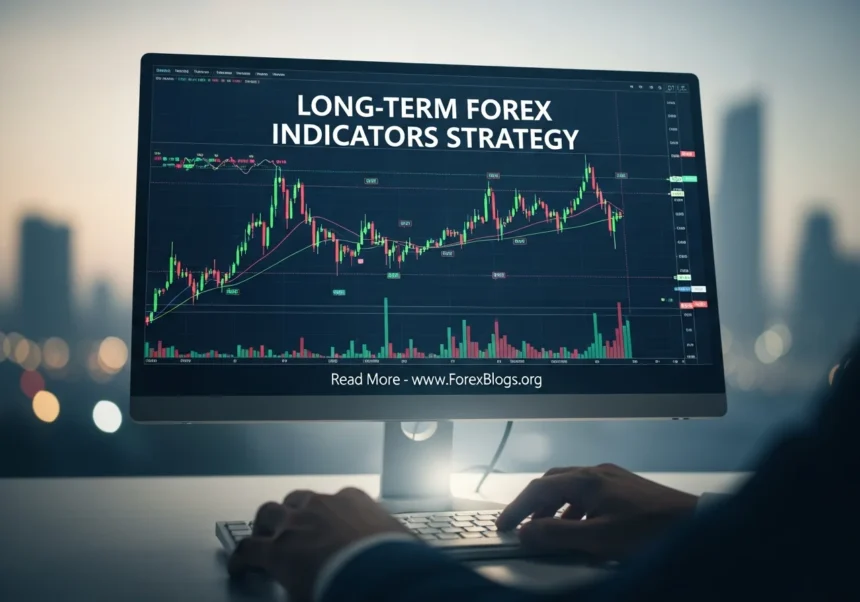
Ever stared at a 5-minute forex chart and felt totally overwhelmed by the chaotic price jumps? You aren’t alone. Day trading is incredibly stressful, and honestly, it’s not the only way to trade currencies. Long-Term Forex Indicators Strategy
- What is a Long-Term Forex Indicators Strategy?
- Why Choose Long-Term Trading Over Day Trading?
- Step-by-Step Guide to Your Long-Term Forex Indicators Strategy
- Step 1: Switch to the Daily Chart
- Step 2: Add the 200-Day Moving Average
- Step 3: Bring in the MACD for Momentum
- Step 4: Use the RSI to Find the Perfect Entry
- Step 5: Put It All Together
- Step 6: Have an Exit Plan
- Common Mistakes to Avoid with Long-Term Forex Trends
- Mistake 1: Checking Your Phone Constantly
- Mistake 2: Setting Your Stop-Loss Too Tight
- Mistake 3: Ignoring Swap Fees
- Mistake 4: Overcomplicating the Chart
- Mistake 5: Forgetting About Major News
- Mistake 6: Lacking Patience
- Frequently Asked Questions
- Which currency pairs are best for a long-term strategy?
- How much money do I need to start long-term trading?
- Can I really just check my charts once a day?
- What if the indicators give me mixed signals?
- Conclusion
That’s where a solid long-term forex indicators strategy comes in. Instead of glued-to-the-screen panic, you can catch the big market moves with way less anxiety.
Let’s break down how to set this up, step by step, even if you are a complete beginner.
What is a Long-Term Forex Indicators Strategy?
Let’s keep this super simple. Forex trading is just buying one currency while selling another. You are betting that one economy will do better than another.
A long-term strategy means you aren’t trying to make a quick buck in ten minutes. Instead, you hold your trades for days, weeks, or even months.
To figure out when to buy or sell, you use “indicators.” These are just visual tools you put on your trading chart to help you spot the overall direction of the market. They do the mathematical heavy lifting for you.
Think of it like planning a cross-country road trip. Day trading is like staring at every single pothole and pebble on the road. It’s exhausting and nerve-wracking.
Long-term trading is like looking at your GPS to see the main highway. You don’t care about the tiny bumps because you know you’re heading in the right overall direction.
By relying on a long-term forex indicators strategy, you filter out the daily noise and focus on the big, profitable trends.
Why Choose Long-Term Trading Over Day Trading?
When most people think of trading, they picture a stressed-out guy in a suit screaming at six computer monitors. That is day trading, and it is a tough way to live.
For a beginner, trying to catch tiny, five-minute price movements is a quick way to lose your shirt. The market is incredibly noisy and unpredictable up close.
A long-term approach lets you step back. You get to sleep peacefully at night, keep your day job, and still participate in massive global market moves.
Plus, long-term trading means you pay fewer fees to your broker because you are placing fewer trades. It is a win-win for someone just starting out.
Step-by-Step Guide to Your Long-Term Forex Indicators Strategy
Setting up your charts might sound technical, but it’s really just clicking a few buttons. Let’s build a straightforward system you can actually use today.
Step 1: Switch to the Daily Chart
First things first, get away from the 1-minute or 5-minute charts. They are full of fake signals and random price spikes that will just confuse you.
Open your trading platform and set your chart to the Daily (D1) timeframe. This means every single candle on your screen represents one full day of trading.
Tip: Looking at the daily chart means you only need to check your trades once a day, usually right after dinner. It takes five minutes.
More Read

Step 2: Add the 200-Day Moving Average
The Moving Average (MA) is the granddaddy of all forex indicators. It smooths out the choppy price action into a single, easy-to-read line.
Find the “Moving Average” tool in your platform and set the period to 200. This shows you the average price over the last 200 days.
If the current price is above this line, the long-term trend is going up. If it’s below the line, the trend is going down. It really is that simple to spot the trend.
Step 3: Bring in the MACD for Momentum
Now we need to know if the trend actually has some strength behind it. For this, we use the MACD (Moving Average Convergence Divergence).
Don’t let the long, complicated name scare you. It’s just a little box that pops up under your main chart with some bars and lines.
When the MACD lines cross and point upwards, it means buyers are taking control of the market. When they cross and point down, sellers are in charge.
Step 4: Use the RSI to Find the Perfect Entry
The Relative Strength Index (RSI) is our final tool. It helps you see if a currency pair is “overbought” (too expensive) or “oversold” (too cheap).
The RSI moves back and forth between 0 and 100. If the line drops below 30, the pair is cheap, and it might be a great time to buy.
If the RSI goes above 70, the currency pair is getting a bit too expensive, signaling it might be time to start selling.
Step 5: Put It All Together
So, how do you actually use this long-term forex indicators strategy to make a trade? You simply wait for all three of your tools to agree.
Let’s say you want to buy the EUR/USD pair. First, make sure the current price is sitting above the 200 Moving Average.
Next, check that your MACD lines are pointing up. Finally, wait for the RSI to dip down near 30 and start turning back up. When all three line up, you confidently enter the trade.
Step 6: Have an Exit Plan
Getting into a trade is only half the battle. You also need a solid plan for getting out and taking your profits.
In a long-term strategy, you ride the trend until your indicators tell you the party is over.
For example, if you bought a currency and the price eventually drops back below the 200 Moving Average, the trend has reversed. That is your signal to pack up, take your money, and close the trade.
Common Mistakes to Avoid with Long-Term Forex Trends
Even with the best strategy in the world, beginners can still trip up. Here are a few traps you need to avoid to protect your money.
Mistake 1: Checking Your Phone Constantly
When you trade the daily chart, things move slowly. Staring at your phone every hour will just make you anxious.
It will tempt you to close a perfectly good trade early just because of a tiny price dip. Set your trade, set your safety nets, and walk away. Let the market do its thing.
Mistake 2: Setting Your Stop-Loss Too Tight
A stop-loss is an automatic order that closes your trade if you start losing too much money. It is a great safety net.
But in long-term trading, the market needs room to breathe. If you set your stop-loss too close to your entry price, a normal daily price swing will kick you out before the real trend even starts. Give your trades some wiggle room.
Mistake 3: Ignoring Swap Fees
When you hold a forex trade overnight, your broker might charge you a tiny fee called a “swap.” Usually, it is just a few cents.
Over a few days, it’s nothing to worry about. But if you hold a trade for three months, those fees can slowly eat into your profits. Always check the swap rates for the pair you are trading beforehand.
Mistake 4: Overcomplicating the Chart
It’s super tempting to add ten different indicators to your screen to feel like a “pro.” Please don’t do it.
Too many indicators will give you mixed signals. One will say buy, the other will say sell, and you’ll just end up paralyzed and confused. Stick to the three core tools we talked about.
Mistake 5: Forgetting About Major News
Even though you are looking at the big picture, massive economic news can still throw a wrench in your plans.
Things like central bank interest rate decisions or major employment reports can cause wild price swings. Just keep a rough eye on a free economic calendar so you aren’t caught entirely off guard.
Mistake 6: Lacking Patience
Sometimes, the market just chops around sideways. Your indicators won’t line up, and you might not get a clear signal to trade for a week or two.
The biggest mistake you can make is forcing a trade out of sheer boredom. Remember that keeping your cash safe is a position too. Waiting on the sidelines is much better than losing money on a bad setup.
Frequently Asked Questions
Which currency pairs are best for a long-term strategy?
Stick to the “major” pairs when you’re just starting out. Pairs like EUR/USD, GBP/USD, or USD/JPY are great because they have clear, steady trends and the lowest trading fees. Exotic pairs can be too erratic for beginners.
How much money do I need to start long-term trading?
You don’t need thousands of dollars. Most modern brokers let you trade “micro lots,” which means you can risk just pennies per trade. You can easily start with $100 to $500 while you learn the ropes.
Can I really just check my charts once a day?
Yes, absolutely. That’s the beauty of looking at the daily timeframe. The daily candle closes at the exact same time every afternoon (depending on your time zone). You just check your charts then, make your decisions, and you’re done for the day.
What if the indicators give me mixed signals?
If the MACD says buy but the price is below the 200 Moving Average, you do absolutely nothing. The golden rule of this strategy is that all your tools must agree. If they don’t, just sit on your hands and wait for the next clear opportunity.
Conclusion
Learning a long-term forex indicators strategy is one of the best favors you can do for yourself as a beginner. It takes away the frantic stress of day trading and lets you actually live your life.
Remember, success in the currency markets isn’t about being the smartest person in the room. It’s about having a simple plan, managing your risk, and having the patience to stick with it.
Take it slow, respect the overall trend, and let the big market moves do the heavy lifting for your account.
Why not open up a free demo account today? Throw the 200 Moving Average, MACD, and RSI on a daily chart and see how it feels. You’ve got this! Happy trading.
#ForexTrading #ForexIndicators #TradingStrategy #LongTermTrading #CurrencyMarket #ForexEducation #TechnicalAnalysis #FinancialMarkets #InvestmentStrategy #FXTrading #ForexSignals #MarketTrends #TradingPsychology #WealthManagement #ForexTips